


DLOSCEPrep

Free lesson

Diagnostic Terminology Standards

The first lesson of Endodontics Board Prep Course (Endo), free to read.

Diagnostic Terminology Standards

Topic: 1.1.1

Course: Endodontics Board Prep Course (Endo)

Audience: American Board of Endodontics board candidates

What you’ll learn

  • Domain: Diagnosis → Pulpal/apical terminology → apply standard pulpal and apical diagnostic terms in board-style cases.
  • Domain: Diagnosis → Test interpretation → separate a diagnosis label from the test finding that supports it.
  • Domain: Clinical decision-making → Documentation → choose wording that is precise, defensible, and useful for treatment planning.
  • Domain: Prognosis/treatment planning → Diagnostic synthesis → distinguish when terminology describes current disease versus prior treatment status.
  • Domain: Scope-aware endodontic reasoning → Referral recognition → recognize when symptoms exceed endodontic terminology alone and require broader differential diagnosis or referral.

Blueprint mapping

  • Diagnosis → pulpal diagnosis terminology → specialist use of accepted labels
  • Diagnosis → apical diagnosis terminology → correlation with history, testing, and imaging
  • Treatment planning → diagnostic synthesis → choosing action after terminology assignment
  • Documentation → standardized charting language → communication across providers

Estimated time: 45–60 minutes

Prereqs: None in this course sequence; upcoming linked topics include History And Symptom Patterns and Pulp Vitality Test Interpretation.

Key outputs: You should be able to choose the correct pulpal and apical diagnosis term, reject imprecise synonyms, document prior treatment status separately from current disease, and identify when the best next step is additional testing or referral rather than forcing an endodontic label.

Why it matters

  • Board questions often make two options sound plausible; the correct choice turns on whether you know the exact accepted diagnostic term, not just the general disease idea.
  • Standard terminology prevents a common specialist error: confusing a test response with a diagnosis, or confusing treatment history with active pathology.
  • Accurate labels drive treatment planning, prognosis communication, referral timing, and defensible documentation.
  • Diagnostic terminology is the language that connects history, testing, imaging, and treatment; if the label is wrong, the next step is usually wrong.

Key Terms & Must-Know Facts

Key terms

  • Normal pulp
  • Reversible pulpitis
  • Symptomatic irreversible pulpitis
  • Asymptomatic irreversible pulpitis
  • Pulp necrosis
  • Previously treated
  • Previously initiated therapy
  • Normal apical tissues
  • Symptomatic apical periodontitis
  • Asymptomatic apical periodontitis
  • Acute apical abscess
  • Chronic apical abscess
  • Condensing osteitis
  • Clinical correlation
  • Diagnostic synthesis

Must-know facts

  • A pulpal diagnosis and an apical diagnosis are assigned separately for the same tooth.
  • “Irreversible pulpitis” is not complete enough on boards unless qualified as symptomatic or asymptomatic when indicated.
  • “Previously treated” and “previously initiated therapy” describe treatment status, not pulpal vitality.
  • Pulp sensibility tests assess neural response, not direct vascular vitality.
  • Normal apical tissues can coexist with symptomatic pulpal disease.
  • Symptomatic apical periodontitis can occur with or without radiographic rarefaction.
  • Acute apical abscess implies rapid onset, pain, and pus formation; swelling may be present.
  • Chronic apical abscess implies gradual onset with drainage tract and often little discomfort.
  • Condensing osteitis is a radiopaque osseous response usually associated with low-grade irritation.
  • If findings do not fit accepted odontogenic terminology, broaden the differential rather than forcing a diagnosis.
Term What it means on exam day What it does not mean
Normal pulp Expected response to testing; no symptoms indicating inflammation beyond normal Not simply “responds to cold,” because controls and symptom context matter
Reversible pulpitis Provoked pain that resolves quickly after stimulus removal Not lingering spontaneous pain
Symptomatic irreversible pulpitis Lingering thermal pain, spontaneous pain, or pain consistent with irreversible inflammation Not every strong cold response
Asymptomatic irreversible pulpitis Irreversible inflammation without current symptoms, often from caries/exposure/deep restoration Not “healthy but deep filling”
Pulp necrosis Nonresponsive pulp in the right context, often with additional findings Not a single failed test by itself
Previously treated Root canal treatment completed Not a pulpal inflammation diagnosis
Previously initiated therapy Partial endodontic treatment already started Not equivalent to necrosis

Core content

1.1.1.1 Foundational framework: two diagnoses, one tooth

A. Explanation

The first board-level choice is whether the answer option is naming the pulpal condition, the apical condition, or the treatment history status. Many candidates miss easy points because they treat these as one bucket. The correct framework is: every evaluated tooth gets a pulpal diagnosis or treatment-status designation and an apical diagnosis. The decision conflict is simple: Are you describing tissue status inside the tooth, tissue status around the apex, or prior endodontic intervention? The single rule that resolves it: if the label tells you whether pulp tissue is inflamed, necrotic, or previously treated, it is pulpal/treatment status; if it describes pain to biting/palpation or periapical radiographic changes, it is apical.

WHY THIS IS TESTED: exam stems often include both thermal symptoms and percussion findings; they want to see whether you can assign two parallel diagnoses rather than collapse the case into one phrase.

Standard endodontic terminology exists to make diagnosis reproducible, treatment planning coherent, and communication with referring dentists precise. “Hot tooth with lingering pain” is not the final answer. “Symptomatic irreversible pulpitis with symptomatic apical periodontitis” may be. A root-canal-treated tooth with tenderness is not “necrotic”; it is “previously treated” with the appropriate apical diagnosis. This distinction matters because treatment options differ: initial treatment versus retreatment versus surgery versus nonendodontic referral.

See Fig 1 for the highest-yield sorting map. See Fig 2 for how pulpal and apical labels combine in actual cases.

Fig 1. Diagnostic terminology sorting map
Exam takeaway: First sort the finding into pulpal status, apical status, or treatment history before choosing a diagnosis label.
flowchart TD
A[Tooth evaluation] --> B{What are you labeling?}
B --> C[Pulp status inside tooth]
B --> D[Apical tissues around root]
B --> E[Prior endodontic treatment status]
C --> C1[Normal pulp]
C --> C2[Reversible pulpitis]
C --> C3[Symptomatic irreversible pulpitis]
C --> C4[Asymptomatic irreversible pulpitis]
C --> C5[Pulp necrosis]
D --> D1[Normal apical tissues]
D --> D2[Symptomatic apical periodontitis]
D --> D3[Asymptomatic apical periodontitis]
D --> D4[Acute apical abscess]
D --> D5[Chronic apical abscess]
D --> D6[Condensing osteitis]
E --> E1[Previously treated]
E --> E2[Previously initiated therapy]
Fig 2. Parallel pulpal and apical assignment
Exam takeaway: One tooth can carry a pulpal label and a separate apical label at the same time.
flowchart LR
A[History and tests] --> B[Pulpal diagnosis]
A --> C[Apical diagnosis]
B --> D[Chart both]
C --> D
D --> E[Treatment decision]
E --> F[Initial treatment or retreatment or referral]
Concept flow: Assigning the right category first
Start with the question
Decide whether the stem is asking about pulpal status, apical status, or treatment history.

Decision point
Thermal/sensibility clues point inward; percussion/palpation/radiolucency clues point apically.

Check history
If endodontic treatment was started or completed, use treatment-status terminology instead of vitality terms.

Chart both diagnoses
Write one pulpal or treatment-status term plus one apical term.

Practitioner Action: Assess: separate the history, sensibility findings, and periapical findings into pulpal versus apical buckets. Intervene: chart both diagnoses using accepted terminology. Refer: if symptoms suggest a nonodontogenic source or restorability/fracture is the true driver, coordinate with the appropriate provider. Document: the exact test results, control teeth, and final paired diagnosis.

B. Worked example

A 36-year-old patient with controlled asthma and hypothyroidism presents with severe cold pain on tooth #19 for 4 days. The pain lingers for about a minute after iced water, wakes the patient at night, and the tooth is mildly tender to biting. There is a large distal-occlusal composite and no swelling. A small unrelated cervical abrasion on #20 makes the patient insist the pain is from that tooth. Cold on #19 produces intense lingering pain; percussion is mildly positive; palpation is negative; radiograph shows no periapical radiolucency.

Reasoning chain: Identify task: choose the correct terminology, not the treatment. Extract key facts: lingering cold pain and spontaneous nocturnal pain support irreversible pulpal inflammation; mild biting tenderness supports apical tissue inflammation even without radiographic change. Apply rule: pulpal and apical diagnoses are assigned separately. Eliminate distractors: reversible pulpitis is tempting because cold provokes pain, but the lingering quality and spontaneous pain reject it; normal apical tissues are tempting because the radiograph is normal, but percussion tenderness rejects that. Verify: the best terminology is symptomatic irreversible pulpitis with symptomatic apical periodontitis.

C. Exam trap

Common wrong answer: Reversible pulpitis with normal apical tissues. WHY IT IS TEMPTING: the stem highlights a cold response and a normal radiograph, which can trigger a superficial “cold-positive equals reversible” shortcut. The SINGLE CLUE that eliminates it: lingering and spontaneous pain move the pulp diagnosis to symptomatic irreversible pulpitis, and percussion tenderness supports symptomatic apical periodontitis even without radiolucency.

D. Checkpoint

Question: A tooth with a completed root canal treatment is tender to percussion and shows a periapical radiolucency. Which terminology set is most appropriate?

  1. A. Pulp necrosis with symptomatic apical periodontitis
  2. B. Previously treated with asymptomatic apical periodontitis
  3. C. Previously treated with symptomatic apical periodontitis
  4. D. Previously initiated therapy with symptomatic apical periodontitis

Answer: C

  • A: Tempting because the tooth has periapical disease, but wrong because a root-canal-treated tooth is not labeled by vitality status.
  • B: Tempting because the radiolucency suggests apical periodontitis, but wrong because percussion tenderness makes it symptomatic.
  • C: Correct because completed treatment requires “previously treated,” and current tenderness supports symptomatic apical periodontitis.
  • D: Tempting because prior intervention occurred, but wrong because “previously initiated therapy” applies when treatment was started, not completed.
If you missed this: Review 1.1.1.1 Foundational framework: two diagnoses, one tooth — focus on separating treatment-status terminology from vitality terminology.

1.1.1.2 Accepted pulpal terminology: what each label commits you to

A. Explanation

The second board-level choice is between pulpal terms that seem adjacent: normal pulp versus reversible pulpitis; reversible versus symptomatic irreversible pulpitis; asymptomatic irreversible pulpitis versus normal pulp in a deep caries/restoration case; pulp necrosis versus inconclusive testing. The decision conflict is: What single symptom pattern or test pattern moves the tooth across the threshold into a stronger diagnosis? The rule is not “how intense was the response?” but whether the overall pattern supports transient, potentially reversible inflammation, irreversible inflammation, no vital neural response, or a tooth already altered by prior treatment.

WHY THIS IS TESTED: many stems are built around one seductive clue, such as a strong cold response, while hiding the real discriminator in the duration, spontaneity, history of exposure, or repeatability of the finding.

Use terms precisely. Normal pulp means the tooth is symptom-free and responds within expected limits compared with controls. Reversible pulpitis means pain is provoked, typically by thermal or sweet stimuli, and resolves quickly after stimulus removal. Symptomatic irreversible pulpitis is supported by lingering thermal pain, spontaneous pain, referred pain patterns, or symptoms consistent with irreversibility. Asymptomatic irreversible pulpitis is used when clinical findings such as carious exposure, deep caries, or other irreversible insults support irreversible inflammation despite absence of current symptoms. Pulp necrosis is used when the pulp is nonvital; however, board-quality reasoning requires the full context, including controls, restorations, calcification, trauma history, and repeat testing, before declaring necrosis from a single nonresponse.

See Fig 3 for a compact comparison of pulpal labels. Forward reference: in the upcoming topic Pulp Vitality Test Interpretation, you will learn how to interpret cold, heat, and electric tests without overcalling necrosis.

Recall: This is the first topic in the course, so there is no prior lesson to build from. Use this section as the terminology base; the upcoming topics on symptom history and sensibility tests will supply the evidence that justifies these labels.
Memory anchor: RLSN for pulpal triage: Resolves quickly = reversible, L\(ingers = symptomatic irreversible\), Silent but deep insult = asymptomatic irreversible, No reliable response = think necrosis after confirming context.
Fig 3. Pulpal diagnosis comparison panel
Exam takeaway: Distinguish reversible, symptomatic irreversible, asymptomatic irreversible, and necrotic patterns by symptom duration and test context rather than response intensity alone.
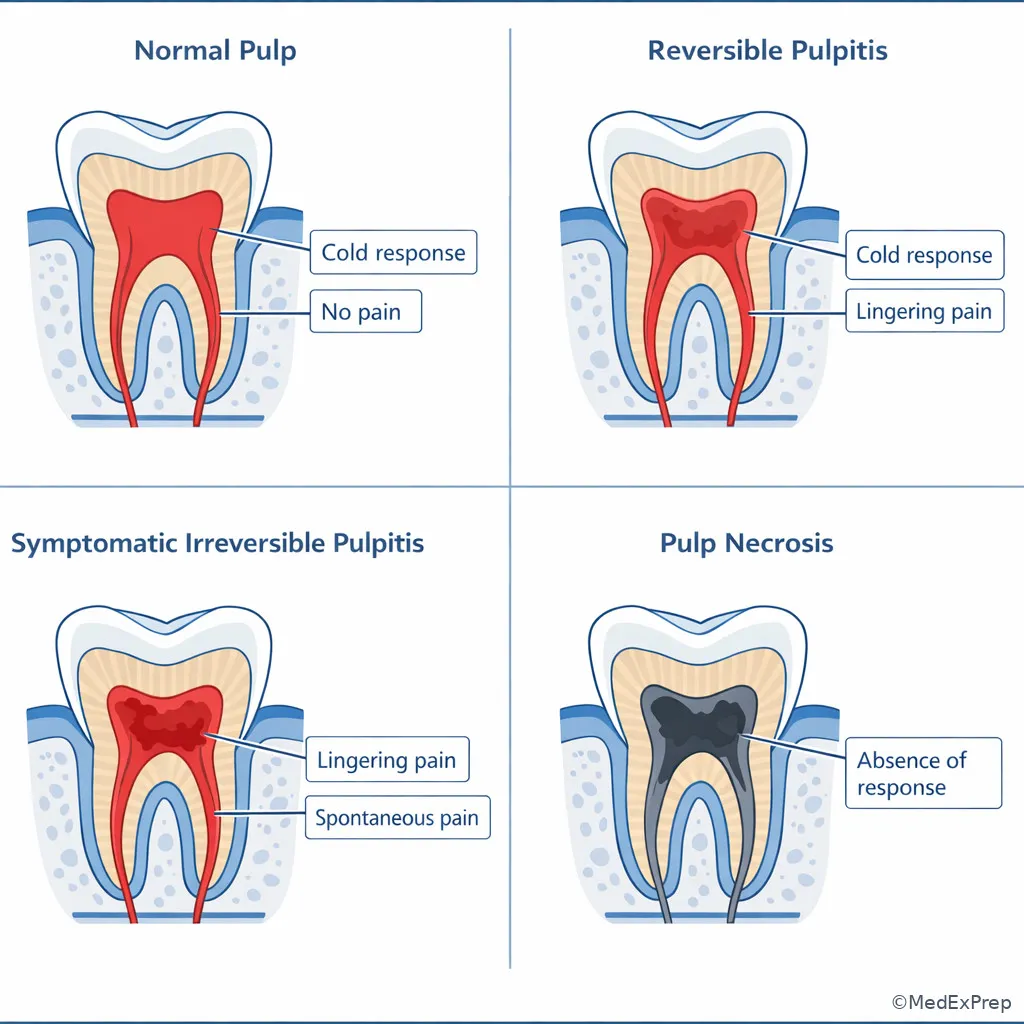
Fig 3. Pulpal diagnosis comparison panel
Pulp inflammation progression illustration
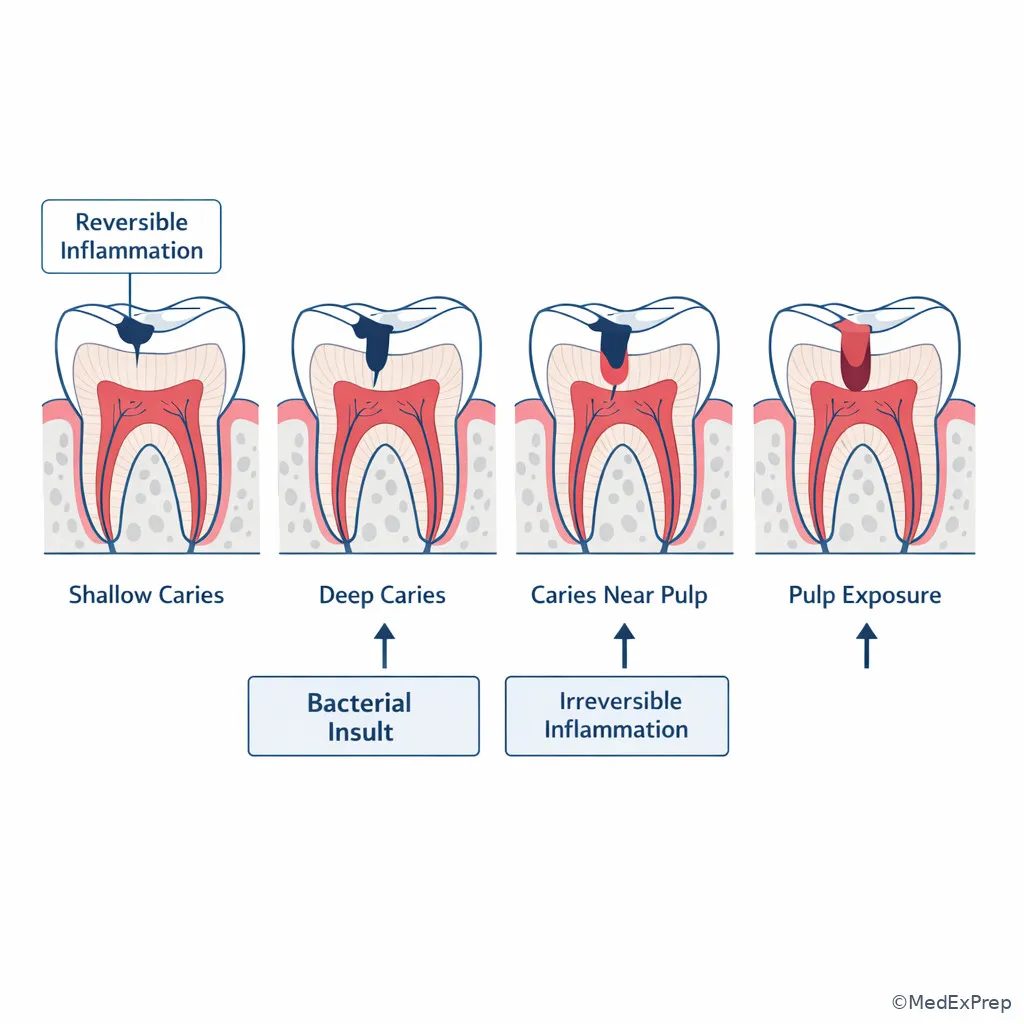
Exam takeaway: Deep caries or exposure without current pain can still support asymptomatic irreversible pulpitis when the tissue insult is irreversible.
Pulp inflammation progression illustration
Concept flow: Choosing a pulpal diagnosis
Start with symptoms
Ask whether pain is absent, provoked only, lingering, or spontaneous.

Resolve versus linger
Quick resolution supports reversible; lingering or spontaneous pain supports symptomatic irreversible.

Check clinical context
Deep caries or exposure without current symptoms can justify asymptomatic irreversible pulpitis.

Confirm nonresponse carefully
Use controls and repeat testing before assigning pulp necrosis.

Practitioner Action: Assess: compare the symptom pattern with control teeth and the restorative/caries context. Intervene: choose the narrowest accepted pulpal term that the evidence supports. Refer: if symptoms are poorly localized or inconsistent with odontogenic disease, consider nonodontogenic evaluation rather than overlabeling a tooth. Document: stimulus type, duration of response, spontaneous symptoms, and any exposure/restorative findings.

B. Worked example

A 52-year-old patient with hypertension and controlled type 2 diabetes is referred for tooth #30 after intermittent sensitivity to cold and sweets. The patient reports the discomfort ends within seconds once the drink is swallowed. A recent crown on #31 makes the patient suspect that tooth instead. Tooth #30 has a deep distal carious lesion but no spontaneous pain. Cold causes a brief sharp response that resolves immediately; percussion and palpation are negative; radiograph shows caries approximating the pulp but no periapical change.

Reasoning chain: Identify task: choose the most appropriate pulpal term. Extract key facts: the pain is provoked, brief, and nonlingering; no spontaneous pain; no apical signs. Apply rule: brief stimulus-dependent pain favors reversible pulpitis. Eliminate distractors: asymptomatic irreversible pulpitis is tempting because of deep caries, but symptoms are present and reversible in pattern; symptomatic irreversible pulpitis is tempting because cold pain exists, but the lack of lingering excludes it. Verify: reversible pulpitis with normal apical tissues is best supported.

C. Exam trap

Common wrong answer: Symptomatic irreversible pulpitis. WHY IT IS TEMPTING: candidates often overweight the depth of caries or the fact that cold causes pain. The SINGLE CLUE that eliminates it: the response resolves quickly after stimulus removal, which supports reversibility.

D. Checkpoint

Question: Which finding most strongly supports asymptomatic irreversible pulpitis rather than normal pulp?

  1. A. Brief cold sensitivity that resolves immediately in an unrestored tooth
  2. B. Deep caries with carious pulp exposure and no current pain
  3. C. Slight tenderness to percussion with no thermal response data
  4. D. A completed root canal treatment with no symptoms

Answer: B

  • A: Tempting because it involves cold response, but the quick resolution is more compatible with normal or reversible patterns, not asymptomatic irreversible pulpitis.
  • B: Correct because irreversible tissue insult can exist despite no current symptoms, especially with deep caries or exposure.
  • C: Tempting because apical tenderness suggests disease, but it does not by itself establish a pulpal label.
  • D: Tempting because it implies no symptoms, but a treated tooth gets the status term “previously treated,” not a vitality diagnosis.
If you missed this: Review 1.1.1.2 Accepted pulpal terminology: what each label commits you to — focus on the difference between transient provoked pain and irreversible tissue insult.
Quick Recall:

  • The pulpal label that requires prior completed root canal therapy is previously treated.
  • True or False: a normal periapical radiograph excludes symptomatic apical periodontitis. False.
  • Name the 3 high-yield separators among reversible pulpitis, symptomatic irreversible pulpitis, and necrosis: duration, spontaneity, and reproducible sensibility response.

1.1.1.3 Accepted apical terminology: symptoms, radiographic change, and drainage

A. Explanation

Apical terminology is where many candidates overdepend on imaging. The decision conflict is: Should the diagnosis follow the patient’s symptoms and clinical signs, the radiograph, or both? The resolving rule is that apical terms are assigned from the total pattern; a radiographic lesion is not required for symptomatic apical periodontitis, and the presence or absence of drainage distinguishes abscess patterns better than pain intensity alone.

WHY THIS IS TESTED: stems often hide the answer in percussion, palpation, swelling, or sinus tract findings while presenting a radiograph that appears normal or only subtly changed.

Normal apical tissues means no pain on percussion or palpation and no apical pathosis signs. Symptomatic apical periodontitis is characterized by pain to biting, percussion, or palpation and may or may not show radiographic changes. Asymptomatic apical periodontitis indicates apical periodontitis of pulpal origin without clinical symptoms, usually with apical radiolucency. Acute apical abscess involves rapid onset, spontaneous pain, tenderness, pus formation, and often swelling. Chronic apical abscess is associated with an intermittent or continuous sinus tract and often minimal discomfort. Condensing osteitis is diffuse radiopacity adjacent to the apex, typically reflecting a low-grade osseous response to inflammation.

See Fig 4 for the apical diagnosis comparison, and see Fig 5 for the decision pathway that separates apical periodontitis from acute versus chronic abscess. This topic overlaps strongly with upcoming History And Symptom Patterns, because drainage, swelling, and pain timing often decide the correct apical term.

High-Yield Connection: This concept is tested alongside Imaging Findings In Diagnosis and Odontogenic Pain Patterns. Know both the clinical trigger for symptomatic apical periodontitis and the imaging limits that prevent overreliance on radiographs.
Fig 4. Apical diagnosis comparison diagram
Exam takeaway: Use tenderness, swelling, drainage, and radiographic context together to choose the apical term rather than relying on imaging alone.
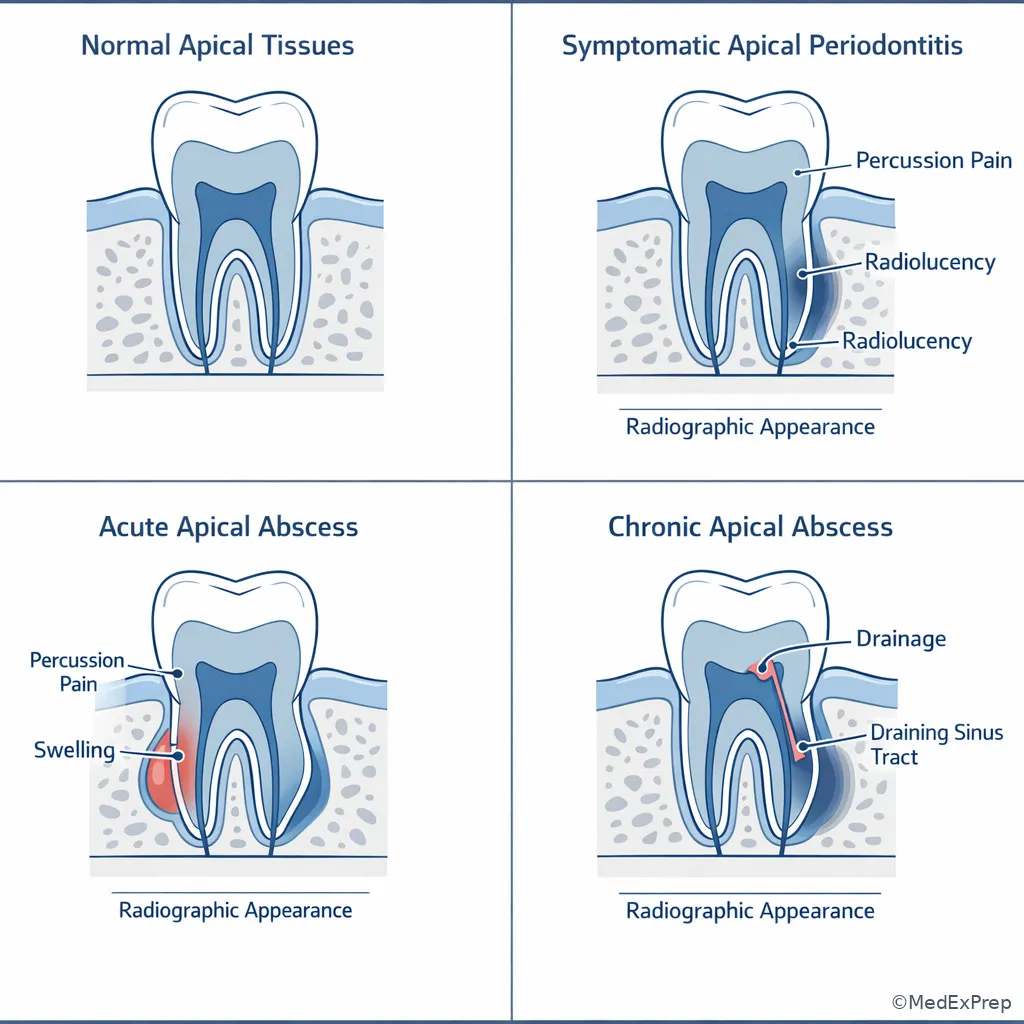
Fig 4. Apical diagnosis comparison diagram
Fig 5. Apical diagnosis decision pathway
Exam takeaway: Tenderness alone supports symptomatic apical periodontitis, while drainage and swelling move the diagnosis toward acute or chronic abscess.
flowchart TD
A[Apical findings present] --> B{Pain to biting or percussion?}
B -->|Yes| C[Symptomatic apical periodontitis]
B -->|No| D{Radiolucency without symptoms?}
D -->|Yes| E[Asymptomatic apical periodontitis]
D -->|No| F{Swelling or pus?}
F -->|Rapid painful swelling| G[Acute apical abscess]
F -->|Sinus tract with drainage| H[Chronic apical abscess]
A --> I{Diffuse apical radiopacity with low-grade irritation?}
I -->|Yes| J[Condensing osteitis]
Condensing osteitis radiographic concept image
Exam takeaway: A radiopaque periapical response suggests low-grade chronic irritation and should not be confused with a sclerotic normal variant without clinical correlation.
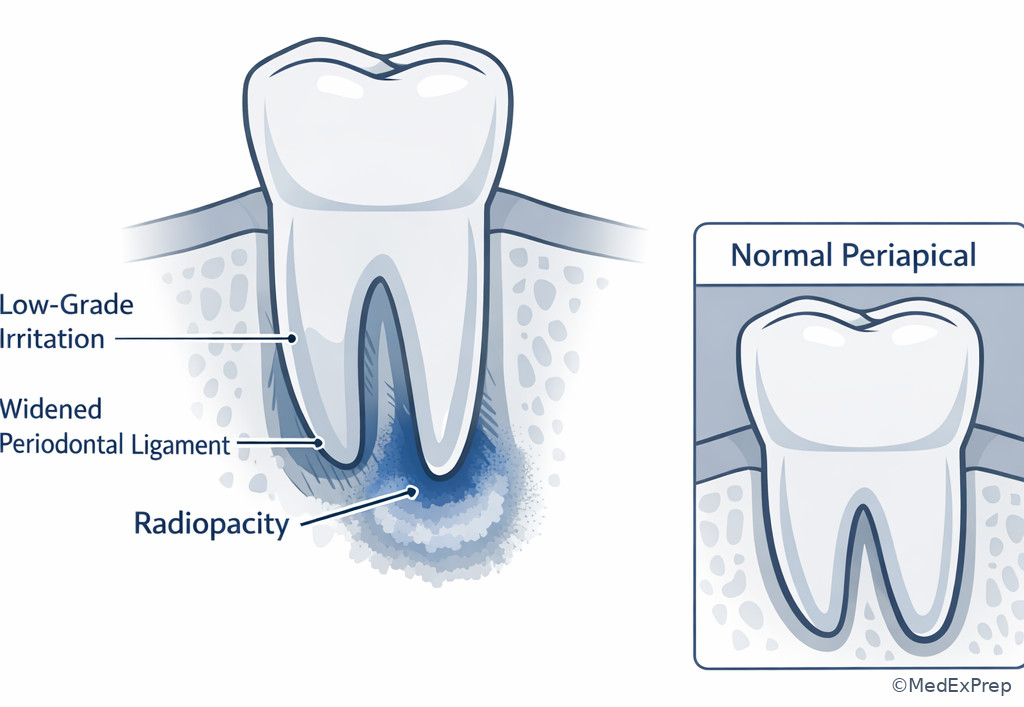
Condensing osteitis radiographic concept image
Concept flow: Choosing an apical diagnosis
Start clinically
Check percussion, palpation, swelling, and sinus tract before deciding from the radiograph.

Tender or not
Tenderness supports symptomatic apical periodontitis even if the image is normal.

Look for drainage and swelling
Rapid painful swelling suggests acute abscess; a sinus tract suggests chronic abscess.

Use radiography to support
Radiolucency helps with asymptomatic apical periodontitis; radiopacity may indicate condensing osteitis.

Practitioner Action: Assess: combine percussion, palpation, swelling, and sinus tract findings with imaging. Intervene: choose the apical term that fits the current periradicular presentation. Refer: if the lesion pattern is atypical for odontogenic disease, enlarging, or inconsistent with endodontic findings, obtain consultation or further evaluation. Document: tenderness level, soft-tissue findings, tracing if performed, and radiographic interpretation limited to endodontic decision-making.

B. Worked example

A 61-year-old patient with osteoarthritis and GERD presents for evaluation of tooth #8. The patient reports no current pain but noticed a recurrent “gum pimple” for several months. There was trauma to the area decades ago and a recent whitening treatment that the patient blames for the problem. Tooth #8 does not respond to cold; it is not tender to percussion; a sinus tract is present and traces to the apex; radiograph shows a periapical radiolucency.

Reasoning chain: Identify task: select both pulpal and apical diagnoses. Extract key facts: no response to sensibility testing supports necrosis in context; sinus tract with drainage and minimal symptoms points to chronic rather than acute abscess. Apply rule: drainage tract is the key differentiator. Eliminate distractors: asymptomatic apical periodontitis is tempting because there is no pain and a radiolucency exists, but the sinus tract elevates the diagnosis to chronic apical abscess; acute apical abscess is tempting because “abscess” suggests swelling, but the chronic draining pattern rejects acute. Verify: pulp necrosis with chronic apical abscess.

C. Exam trap

Common wrong answer: Asymptomatic apical periodontitis. WHY IT IS TEMPTING: the patient is not in pain and the radiograph shows a classic periapical radiolucency. The SINGLE CLUE that eliminates it: the sinus tract indicates chronic drainage, making the correct apical term chronic apical abscess.

D. Checkpoint

Question: A patient has severe pain on biting tooth #3, marked percussion sensitivity, no swelling, and no radiographic lesion. Which apical diagnosis is most appropriate?

  1. A. Normal apical tissues
  2. B. Symptomatic apical periodontitis
  3. C. Asymptomatic apical periodontitis
  4. D. Acute apical abscess

Answer: B

  • A: Tempting because the radiograph is normal, but wrong because clinical tenderness rules out normal apical tissues.
  • B: Correct because biting and percussion pain define symptomatic apical periodontitis even before radiographic change appears.
  • C: Tempting because apical periodontitis can be radiographic, but “asymptomatic” is contradicted by pain.
  • D: Tempting because the pain is severe, but wrong because abscess terminology requires suppuration and typically swelling or drainage findings.
If you missed this: Review 1.1.1.3 Accepted apical terminology: symptoms, radiographic change, and drainage — focus on the rule that symptomatic apical periodontitis does not require a visible radiolucency.

1.1.1.4 Treatment status terms, incomplete data, and documentation discipline

A. Explanation

The final foundational integration step is knowing when not to use a vitality term. The decision conflict is: Should you call this pulp necrosis or irreversible pulpitis, or does the stem really require a treatment-status designation or additional diagnostic qualification? The resolving rule: once a tooth has completed root canal treatment, use previously treated; if endodontic therapy has been started but not completed, use previously initiated therapy. These terms replace pulpal vitality labels because the original pulp status is no longer the clinically operative category.

WHY THIS IS TESTED: exam writers use common charting shortcuts and casual language as distractors. “RCT tooth with necrotic pulp” is internally inconsistent. So is guessing necrosis from one failed sensibility test in a calcified or traumatized tooth without corroboration.

Documentation discipline also means recognizing uncertainty honestly. A board-level endodontist should not force a neat label when data are incomplete or conflicting. Instead, gather more history, repeat sensibility testing with controls, obtain appropriate imaging, consider crack testing, or expand the differential diagnosis. Within scope, your job is to assign accepted terminology when justified and to recognize when broader evaluation is safer. This is especially important when the true pivot in the case is not endodontic terminology but restorability, fracture, periodontal support, or nonodontogenic pain.

See Fig 6 for the documentation and terminology safety checklist. This section will connect directly to upcoming lessons on symptom patterns and pulp test interpretation, where many apparent “terminology mistakes” are actually evidence-collection mistakes.

Key rule: Do not use “pulp necrosis” for a tooth with completed root canal treatment. Use “previously treated” and then assign the apical diagnosis separately.
High-Yield Connection: This concept is tested alongside Restorability And Strategic Value and Nonodontogenic Pain Red Flags. The exam may tempt you to keep reasoning within endodontic terminology when the safer answer is to pause, clarify, and co-manage.
Fig 6. Documentation safety checklist for diagnostic terminology
Exam takeaway: When prior treatment exists or data are incomplete, chart treatment status accurately and gather missing evidence before forcing a vitality label.
flowchart TD
A[Diagnostic charting] --> B{Has root canal treatment been completed?}
B -->|Yes| C[Use Previously Treated]
B -->|No| D{Has endodontic therapy started?}
D -->|Yes| E[Use Previously Initiated Therapy]
D -->|No| F[Choose pulpal vitality diagnosis]
F --> G{Data conflicting or incomplete?}
G -->|Yes| H[Repeat tests, add imaging, expand differential]
G -->|No| I[Finalize paired pulpal and apical diagnoses]
Endodontic charting and diagnosis worksheet illustration
Exam takeaway: Structured charting reduces the common error of mixing treatment status, pulpal diagnosis, and apical diagnosis in one imprecise label.
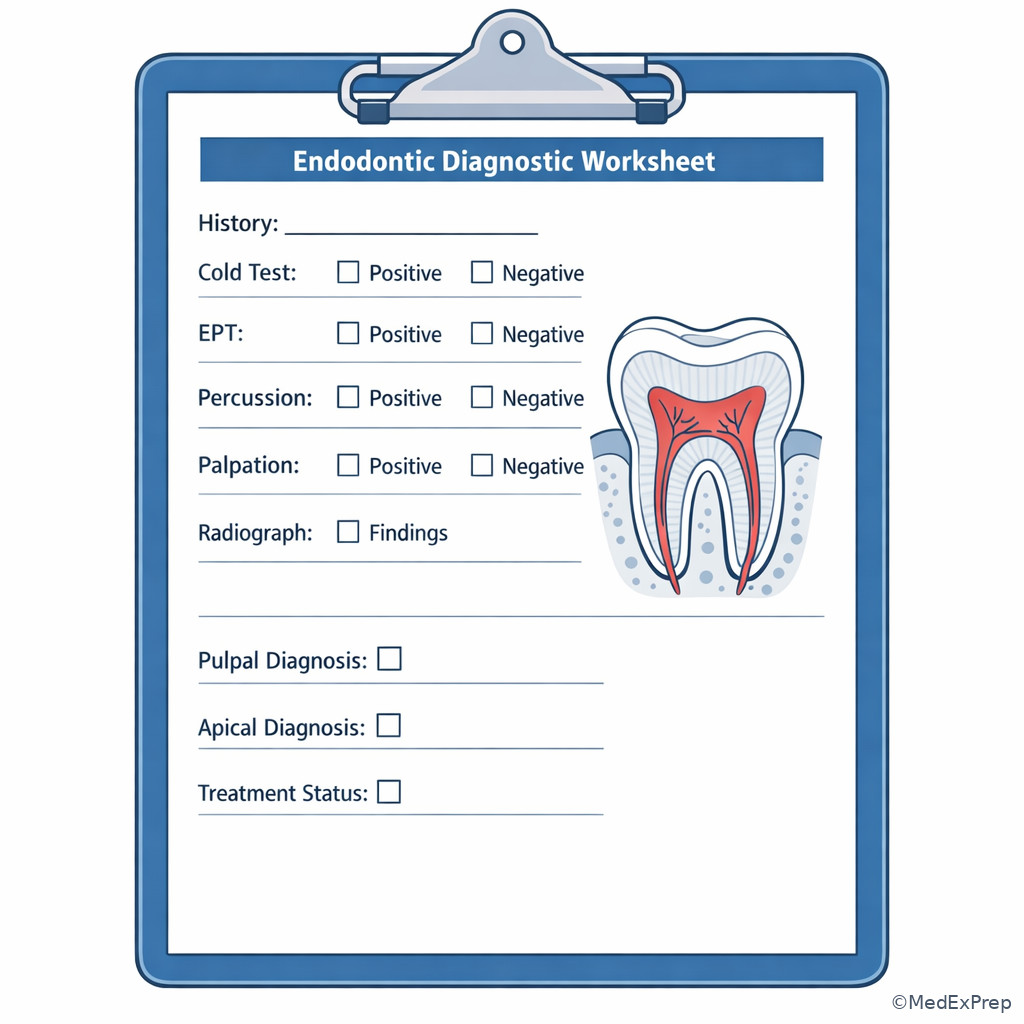
Endodontic charting and diagnosis worksheet illustration
Failed versus inconclusive pulp testing image
Exam takeaway: A single nonresponse should trigger confirmation steps, especially in calcified, traumatized, or heavily restored teeth.
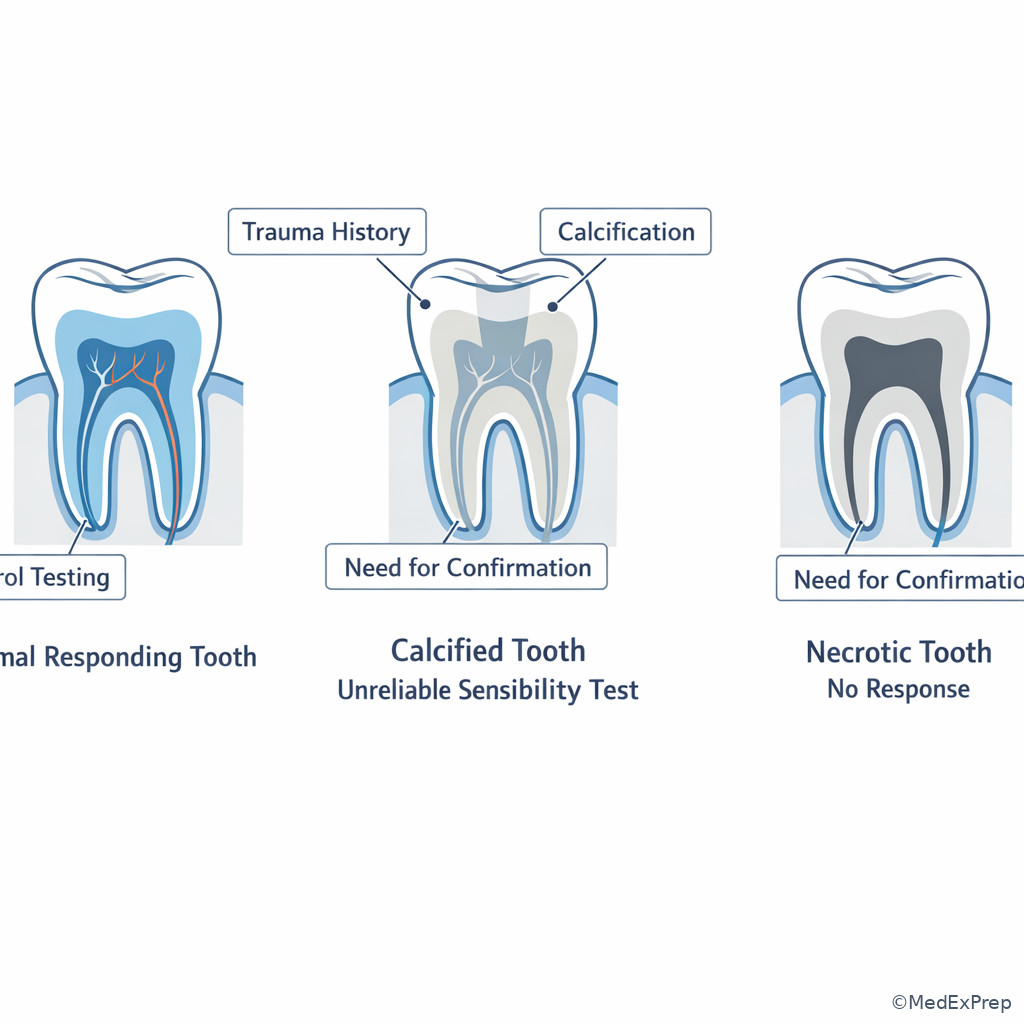
Failed versus inconclusive pulp testing image
Concept flow: Safe terminology when prior treatment or uncertainty exists
Check treatment history
Determine whether treatment was completed, started, or never begun.

Choose status term when indicated
Completed treatment means previously treated; partial treatment means previously initiated therapy.

Do not force certainty
If tests conflict, add data rather than overcalling necrosis or irreversibility.

Document paired diagnosis
Record treatment status or pulpal term plus the current apical diagnosis and basis.

Practitioner Action: Assess: confirm prior endodontic intervention and the reliability of current tests. Intervene: use treatment-status terminology when appropriate and seek additional diagnostic data when findings conflict. Refer: if fracture, periodontal compromise, nonodontogenic pain, or restorability drives the prognosis, co-manage with the relevant specialist or referring dentist. Document: what is known, what remains uncertain, and why the chosen terminology is justified.

B. Worked example

A 47-year-old patient with migraines and bruxism presents with dull discomfort on tooth #14, which had root canal treatment 5 years ago. A large crown is present, and the patient recently started chewing gum more often, making occlusal overload a tempting explanation. Percussion is mildly positive; palpation is negative; radiograph shows a small periapical radiolucency. The referring dentist writes, “possible necrotic tooth after prior endo.”

Reasoning chain: Identify task: correct the terminology. Extract key facts: root canal treatment was completed; therefore vitality terminology is no longer appropriate. Apical findings include tenderness and radiolucency, supporting symptomatic apical periodontitis. Apply rule: treatment history term replaces pulpal status term. Eliminate distractors: pulp necrosis is tempting because the lesion persists, but a completed RCT tooth cannot be charted as necrotic; previously initiated therapy is tempting because treatment happened in the past, but it was completed, not partial. Verify: previously treated with symptomatic apical periodontitis.

C. Exam trap

Common wrong answer: Pulp necrosis with symptomatic apical periodontitis. WHY IT IS TEMPTING: persistent apical disease feels intuitively linked to a “dead” tooth. The SINGLE CLUE that eliminates it: the tooth already had completed root canal treatment, so the correct pulpal-status designation is previously treated.

D. Checkpoint

Question: Which chart entry is most appropriate for a tooth in which pulpectomy was begun at an emergency visit, canals were partially instrumented, and the patient now returns with no obturation completed?

  1. A. Previously treated
  2. B. Previously initiated therapy
  3. C. Pulp necrosis
  4. D. Asymptomatic irreversible pulpitis

Answer: B

  • A: Tempting because treatment has occurred, but wrong because it was not completed.
  • B: Correct because endodontic treatment was started but not completed.
  • C: Tempting because pulpal tissue may no longer be viable, but treatment-status terminology is the proper label once therapy has been initiated.
  • D: Tempting if the original emergency diagnosis was irreversible pulpitis, but that history no longer serves as the current chart term after therapy was started.
If you missed this: Review 1.1.1.4 Treatment status terms, incomplete data, and documentation discipline — focus on when treatment-status terms replace vitality terms.
Quick Recall:

  • The key finding that separates chronic apical abscess from asymptomatic apical periodontitis is a sinus tract or drainage.
  • True or False: a root-canal-treated tooth can be labeled “pulp necrosis.” False.
  • Name the two treatment-status terms: previously treated and previously initiated therapy.

Exam Traps & Differentiators

  • Most common wrong answer and why: choosing a single diagnosis phrase when the tooth actually needs both pulpal and apical labels. This happens because the stem emphasizes one symptom stream more than the other.
  • Looks similar but isn’t: a strong cold response is not automatically symptomatic irreversible pulpitis; the duration after stimulus removal is more important than response intensity alone.
  • Looks similar but isn’t: a periapical radiolucency without symptoms is not chronic apical abscess unless a sinus tract or drainage is present.
  • Looks similar but isn’t: a previously treated tooth with apical disease is not “necrotic”; the pulpal side is charted as treatment status.
  • If the stem says lingering cold pain, spontaneous nocturnal pain think symptomatic irreversible pulpitis.
  • If the stem says provoked cold sensitivity that stops immediately think reversible pulpitis unless a stronger contradicting clue is present.
  • If the stem says no symptoms but carious exposure or deep irreversible insult think asymptomatic irreversible pulpitis.
  • If the stem says percussion tenderness with normal radiograph think symptomatic apical periodontitis can still be correct.
  • If the stem says sinus tract tracing to apex think chronic apical abscess, not just asymptomatic apical periodontitis.
  • If the stem says completed RCT in the history think previously treated before considering the apical label.
Confusable pair Why candidates confuse them Single best differentiator
Reversible pulpitis vs symptomatic irreversible pulpitis Both can hurt to cold Lingering/spontaneous pain supports symptomatic irreversible pulpitis
Asymptomatic irreversible pulpitis vs normal pulp Both may be painless at the visit Deep irreversible insult or exposure supports asymptomatic irreversible pulpitis
Symptomatic apical periodontitis vs normal apical tissues Radiograph may look normal in both Pain to percussion, biting, or palpation supports symptomatic apical periodontitis
Asymptomatic apical periodontitis vs chronic apical abscess Both can have radiolucency and little pain Drainage tract indicates chronic apical abscess
Previously treated vs pulp necrosis Both imply nonvital internal status Completed root canal history requires previously treated
Stem clue Think first Reject if
“Cold causes pain that lingers 45 seconds” Symptomatic irreversible pulpitis The pain actually resolves immediately on repeated testing
“No pain, sinus tract present” Chronic apical abscess Tracing does not connect to the apex or source is nonodontogenic
“RCT completed years ago” Previously treated The procedure was only an emergency pulpotomy or partial instrumentation
“Tender to percussion, no lesion” Symptomatic apical periodontitis Tenderness localizes instead to crack/occlusion and endodontic findings are absent
“Deep caries, no symptoms today” Consider asymptomatic irreversible pulpitis The tissue insult is not clearly irreversible and tests are normal

Related trap from upcoming topics: in History And Symptom Patterns, the exam will often make a wrong tooth sound guilty based on referred pain or a recent restoration. In Pulp Vitality Test Interpretation, a single false-negative sensibility test can make necrosis look appealing. Here, the key defense is terminology discipline: do not label beyond what the total evidence supports.

Review connection: The traps above test whether you can separate symptom evidence, apical signs, and treatment history into the correct terminology buckets. If any felt unfamiliar, revisit 1.1.1.1 Foundational framework: two diagnoses, one tooth and 1.1.1.4 Treatment status terms, incomplete data, and documentation discipline before attempting the Self-check quiz.

Algorithm / Approach

Concept flow: Specialist approach to assigning standard endodontic terminology
Clarify the target tooth and complaint
Use history, controls, and clinical exam to avoid diagnosing the wrong tooth.

Check prior endodontic status
Completed RCT → previously treated; partial treatment → previously initiated therapy; otherwise continue pulpal diagnosis.

Assign pulpal diagnosis
Use symptom duration, spontaneity, exposure/deep caries context, and reproducible sensibility results.

Assign apical diagnosis
Use percussion, palpation, swelling, sinus tract, and radiographic pattern together.

Conflict check
If findings do not fit cleanly, repeat tests, add imaging, assess crack/restorability, or broaden differential.

Document and plan
Record paired terminology, supporting findings, prognosis context, and the most appropriate next endodontic action.

Rapid Review

  • Normal pulp → expected response pattern with no symptom history suggesting active inflammation
  • Reversible pulpitis → provoked pain that stops quickly after stimulus removal
  • Symptomatic irreversible pulpitis → lingering or spontaneous pain outweighs mere response intensity
  • Asymptomatic irreversible pulpitis → irreversible insult present even when the patient denies pain
  • Pulp necrosis → nonresponse must fit the full context, not a single isolated test
  • Previously treated → completed root canal therapy replaces vitality terminology
  • Previously initiated therapy → treatment started but not finished
  • Normal apical tissues → no percussion/palpation pain and no apical pathosis evidence
  • Symptomatic apical periodontitis → tenderness can exist before radiographic change
  • Asymptomatic apical periodontitis → radiolucency without clinical symptoms
  • Acute apical abscess → rapid painful suppurative process, often swelling
  • Chronic apical abscess → draining sinus tract is the discriminator
  • Condensing osteitis → radiopaque apical response to low-grade irritation
  • Board stems → ask yourself first: pulpal term, apical term, or treatment-status term?
Memory anchor: PAIR your diagnosis: Pulpal/status term, Apical term, Integrate evidence, Reject shortcuts.

Self-check quiz

1. A 29-year-old patient with seasonal allergies and a recent occlusal composite on tooth #12 reports cold sensitivity that lasts 2 to 3 seconds and stops immediately. Percussion and palpation are negative, and the radiograph is unremarkable. Which pulpal diagnosis is most appropriate?

  1. A. Normal pulp
  2. B. Reversible pulpitis
  3. C. Symptomatic irreversible pulpitis
  4. D. Asymptomatic irreversible pulpitis

2. A tooth had complete root canal treatment 3 years ago. The patient now presents for evaluation because of a periapical radiolucency found on a routine radiograph, but there are no symptoms. Which pulpal or status term is most appropriate?

  1. A. Pulp necrosis
  2. B. Previously initiated therapy
  3. C. Previously treated
  4. D. Asymptomatic irreversible pulpitis

3. A 41-year-old patient with hyperlipidemia and controlled anxiety presents with tooth #19 pain that begins with cold and lingers for 45 seconds. The tooth is mildly tender to percussion. There is a large mesio-occlusal restoration and no swelling. The periapical radiograph shows no apical radiolucency. Which paired diagnosis is most appropriate?

  1. A. Reversible pulpitis with normal apical tissues
  2. B. Symptomatic irreversible pulpitis with symptomatic apical periodontitis
  3. C. Symptomatic irreversible pulpitis with asymptomatic apical periodontitis
  4. D. Pulp necrosis with symptomatic apical periodontitis

4. A 58-year-old patient with controlled hypertension and a history of childhood trauma to tooth #9 presents with a recurrent sinus tract in the labial mucosa. The tooth does not respond to cold, is not tender to percussion, and shows an apical radiolucency. The patient denies pain and blames recent bleaching. Which apical diagnosis is most appropriate?

  1. A. Asymptomatic apical periodontitis
  2. B. Symptomatic apical periodontitis
  3. C. Acute apical abscess
  4. D. Chronic apical abscess

5. A 34-year-old patient with GERD and bruxism was seen emergently 1 week ago for severe pain on tooth #30. The referring dentist opened the pulp chamber and removed part of the coronal pulp, but no obturation was completed. The patient now returns for definitive care. Which status term requires charting?

  1. A. Previously treated
  2. B. Previously initiated therapy
  3. C. Pulp necrosis
  4. D. Symptomatic irreversible pulpitis

6. A 63-year-old patient with type 2 diabetes and coronary artery disease presents with biting pain on tooth #3. The tooth has a full crown and no prior endodontic treatment. Cold produces no response compared with adjacent controls; percussion is positive; palpation is negative; there is no swelling. Radiograph shows widened periodontal ligament space but no distinct radiolucency. Which paired diagnosis is most appropriate?

  1. A. Pulp necrosis with symptomatic apical periodontitis
  2. B. Symptomatic irreversible pulpitis with symptomatic apical periodontitis
  3. C. Pulp necrosis with asymptomatic apical periodontitis
  4. D. Previously treated with symptomatic apical periodontitis

7. A 50-year-old patient with hypothyroidism and chronic sinus issues presents with tooth #14, which has deep distal recurrent caries under a crown. The patient reports no spontaneous pain, but examination reveals a pinpoint carious exposure during caries removal by the referring dentist. Cold testing before anesthesia had shown no lingering pain, and percussion is negative. Which pulpal diagnosis is most appropriate before definitive endodontic treatment planning?

  1. A. Normal pulp
  2. B. Reversible pulpitis
  3. C. Asymptomatic irreversible pulpitis
  4. D. Pulp necrosis

8. A 45-year-old patient with migraines and a recent orthodontic adjustment presents with diffuse maxillary pain. Tooth #10 had root canal treatment 6 years ago. It is mildly tender to percussion and shows a small apical radiolucency. Another untreated premolar has intense lingering cold pain but no apical tenderness. Which charting choice most appropriately applies diagnostic terminology to tooth #10 specifically?

  1. A. Pulp necrosis with symptomatic apical periodontitis
  2. B. Previously treated with symptomatic apical periodontitis
  3. C. Previously treated with asymptomatic apical periodontitis
  4. D. Symptomatic irreversible pulpitis with symptomatic apical periodontitis

Answer key

1. Answer: B — Reversible pulpitis

  • A: Tempting because the symptoms are mild and the radiograph is normal. Incorrect for this scenario because the tooth does have provoked sensitivity after a recent restoration; that pattern fits reversible pulpitis rather than a completely normal pulp. Single discriminating clue: cold sensitivity is present but brief. Source: AAE diagnostic terminology guidance; Torabinejad and Walton.
  • B: Correct because provoked cold pain that stops immediately after stimulus removal is classic for reversible pulpitis when correlated with the restorative history. Single discriminating clue: response resolves within seconds. Source: AAE Consensus Conference Recommended Diagnostic Terminology; Hargreaves and Berman.
  • C: Tempting because cold pain exists. Incorrect because symptomatic irreversible pulpitis usually includes lingering or spontaneous pain, neither of which is present here. Single discriminating clue: no lingering pain. Source: AAE terminology; Ingle’s Endodontics.
  • D: Tempting because a restoration can be deep. Incorrect because asymptomatic irreversible pulpitis requires an irreversible insult without current symptoms, whereas this stem gives a reversible symptom pattern. Single discriminating clue: symptoms are present and brief, not silent with irreversible evidence. Source: AAE terminology; Walton and Torabinejad.
If you missed this: Review 1.1.1.2 Accepted pulpal terminology: what each label commits you to — focus on the duration of pain after cold removal.

2. Answer: C — Previously treated

  • A: Tempting because a treated tooth is functionally nonvital. Incorrect because completed root canal history changes the chart terminology to treatment status, not vitality diagnosis. Single discriminating clue: complete root canal treatment 3 years ago. Source: AAE diagnostic terminology guidance.
  • B: Tempting because prior endodontic intervention occurred. Incorrect because this term is reserved for therapy started but not finished. Single discriminating clue: treatment was complete. Source: AAE terminology consensus.
  • C: Correct because a fully root-canal-treated tooth is designated previously treated regardless of the current apical diagnosis. Single discriminating clue: completed treatment history. Source: AAE terminology; Cohen’s Pathways of the Pulp.
  • D: Tempting because the tooth is asymptomatic. Incorrect because vitality terms no longer apply after completed root canal treatment. Single discriminating clue: status term supersedes pulpal vitality label. Source: AAE terminology consensus.
If you missed this: Review 1.1.1.4 Treatment status terms, incomplete data, and documentation discipline — focus on when “previously treated” replaces any vitality term.

3. Answer: B — Symptomatic irreversible pulpitis with symptomatic apical periodontitis

  • A: Tempting because cold triggers pain and the radiograph is normal. Incorrect because pain lingering 45 seconds exceeds a reversible pattern, and percussion tenderness rules out normal apical tissues. Single discriminating clue: lingering cold pain plus percussion tenderness. Source: AAE terminology; Hargreaves and Berman.
  • B: Correct because lingering cold pain supports symptomatic irreversible pulpitis and percussion tenderness supports symptomatic apical periodontitis even without radiographic rarefaction. Single discriminating clue: duration of cold pain and clinical tenderness. Source: AAE terminology consensus; Torabinejad and Walton.
  • C: Tempting because apical periodontitis can appear radiographically later. Incorrect because the patient is symptomatic apically now; asymptomatic apical periodontitis would not fit percussion pain. Single discriminating clue: tenderness makes the apical term symptomatic. Source: AAE guidance.
  • D: Tempting because severe pulpal inflammation can progress to necrosis. Incorrect because the tooth still gives a meaningful lingering cold response, which argues against necrosis in this stem. Single discriminating clue: positive lingering cold response. Source: Cohen’s Pathways; AAE terminology.
If you missed this: Review 1.1.1.1 Foundational framework: two diagnoses, one tooth and 1.1.1.3 Accepted apical terminology — focus on assigning both pulpal and apical labels independently.

4. Answer: D — Chronic apical abscess

  • A: Tempting because the patient has no pain and there is an apical radiolucency. Incorrect because the presence of a sinus tract indicates a draining abscess rather than simple asymptomatic apical periodontitis. Single discriminating clue: recurrent sinus tract. Source: AAE terminology; Ingle’s Endodontics.
  • B: Tempting because trauma history can create apical disease. Incorrect because the patient is not apically symptomatic. Single discriminating clue: no percussion pain and no tenderness. Source: AAE terminology consensus.
  • C: Tempting because abscess terminology seems to fit drainage. Incorrect because acute apical abscess implies rapid onset and painful swelling, not a chronic draining tract with minimal discomfort. Single discriminating clue: longstanding drainage with little pain. Source: AAE guidance; Walton and Torabinejad.
  • D: Correct because a sinus tract draining from an apical lesion with minimal symptoms defines chronic apical abscess. Single discriminating clue: sinus tract traced to the apex. Source: AAE terminology consensus.
If you missed this: Review 1.1.1.3 Accepted apical terminology: symptoms, radiographic change, and drainage — focus on the role of a sinus tract in distinguishing chronic apical abscess.

5. Answer: B — Previously initiated therapy

  • A: Tempting because endodontic treatment has begun. Incorrect because “previously treated” requires completed root canal treatment. Single discriminating clue: no obturation was completed. Source: AAE terminology.
  • B: Correct because the dentist began endodontic therapy but did not complete it, which is exactly the use of previously initiated therapy. Single discriminating clue: emergency partial treatment. Source: AAE terminology consensus.
  • C: Tempting because the remaining pulp may be compromised. Incorrect because once therapy has started, treatment-status terminology is preferred over vitality labeling for charting. Single discriminating clue: access and partial pulp removal already occurred. Source: AAE terminology guidance.
  • D: Tempting because that may have been the original disease. Incorrect because the chart now must reflect current treatment status, not merely the likely pretreatment diagnosis. Single discriminating clue: prior endodontic intervention supersedes original vitality term in charting. Source: Cohen’s Pathways; AAE terminology.
If you missed this: Review 1.1.1.4 Treatment status terms, incomplete data, and documentation discipline — focus on incomplete versus completed endodontic treatment.

6. Answer: A — Pulp necrosis with symptomatic apical periodontitis

  • A: Correct because the tooth has no prior endodontic treatment, shows no response to cold compared with controls, and is tender to percussion; together these findings support pulp necrosis with symptomatic apical periodontitis. Single discriminating clue: absent cold response in an untreated tooth plus percussion pain. Source: AAE terminology; Hargreaves and Berman.
  • B: Tempting because symptomatic apical periodontitis is clearly present and crowned teeth can be difficult to test. Incorrect because there is no lingering thermal response or spontaneous pulpal pain; instead the stem gives nonresponse. Single discriminating clue: absent cold response, not lingering response. Source: AAE terminology consensus.
  • C: Tempting because the radiographic changes are subtle. Incorrect because the tooth is not asymptomatic apically; percussion is positive. Single discriminating clue: biting/percussion pain. Source: AAE guidance.
  • D: Tempting because crowned teeth are often restored and confusing. Incorrect because there is no prior root canal treatment in the history. Single discriminating clue: no prior endodontic treatment. Source: AAE terminology.
If you missed this: Review 1.1.1.2 Accepted pulpal terminology and 1.1.1.3 Accepted apical terminology — focus on combining untreated-tooth nonresponse with symptomatic apical findings.

7. Answer: C — Asymptomatic irreversible pulpitis

  • A: Tempting because there is no spontaneous pain and percussion is negative. Incorrect because carious exposure during removal indicates an irreversible tissue insult inconsistent with normal pulp. Single discriminating clue: pinpoint carious exposure. Source: AAE terminology; Walton and Torabinejad.
  • B: Tempting because cold had not lingered, which might suggest a reversible pattern. Incorrect because the direct evidence of irreversible insult from exposure overrides a purely reversible interpretation. Single discriminating clue: exposure/deep irreversible lesion, not just symptom duration. Source: AAE guidance; Cohen’s Pathways.
  • C: Correct because the tooth lacks current spontaneous symptoms but shows a clinical condition consistent with irreversible pulpal involvement. Single discriminating clue: irreversible structural insult without current symptoms. Source: AAE terminology consensus.
  • D: Tempting because deep recurrent caries may lead to necrosis. Incorrect because the stem does not provide convincing nonresponse or necrotic evidence. Single discriminating clue: no necrosis-specific testing pattern. Source: Hargreaves and Berman.
If you missed this: Review 1.1.1.2 Accepted pulpal terminology: what each label commits you to — focus on asymptomatic irreversible pulpitis as an evidence-based structural diagnosis, not just a symptom-based one.

8. Answer: B — Previously treated with symptomatic apical periodontitis

  • A: Tempting because the tooth has apical pathology and prior RCT implies no vital pulp. Incorrect because a completed RCT tooth is charted as previously treated, not pulp necrosis. Single discriminating clue: root canal treatment 6 years ago. Source: AAE terminology.
  • B: Correct because tooth #10 specifically has completed endodontic treatment, is tender to percussion, and has an apical radiolucency; that supports previously treated with symptomatic apical periodontitis. Single discriminating clue: completed RCT plus current percussion tenderness. Source: AAE terminology consensus; Ingle’s Endodontics.
  • C: Tempting because the apical radiolucency could be chronic and the patient has diffuse pain from other causes. Incorrect because the tooth itself is mildly tender to percussion, making the apical component symptomatic. Single discriminating clue: tenderness on percussion. Source: AAE guidance.
  • D: Tempting because another tooth in the case has lingering cold pain, creating diagnostic noise. Incorrect because the question asks specifically about tooth #10, which is already treated and cannot be labeled symptomatic irreversible pulpitis. Single discriminating clue: the lingering cold pain belongs to a different untreated tooth. Source: AAE terminology; specialist charting standards.
If you missed this: Review 1.1.1.1 Foundational framework: two diagnoses, one tooth and 1.1.1.4 Treatment status terms, incomplete data, and documentation discipline — focus on tooth-specific charting and rejecting vitality labels for previously treated teeth.

References

  • American Association of Endodontists. Consensus Conference Recommended Diagnostic Terminology. AAE, current official terminology resource.
  • Hargreaves, Kenneth M., and Louis H. Berman, editors. Cohen’s Pathways of the Pulp. 12th ed., Elsevier.
  • Torabinejad, Mahmoud, Ashraf F. Fouad, and Shabahang S. Endodontics: Principles and Practice. 6th ed., Elsevier.
  • Ingle, John I., et al., editors. Ingle’s Endodontics. 7th ed., PMPH USA.
  • American Association of Endodontists. Endodontic Diagnosis. AAE Colleagues for Excellence and clinical guidance documents.

Last reviewed: March 15, 2026

Lesson 2

History And Symptom Patterns

Diagnostic Foundations | Pulpal and Apical Diagnosis | Foundational

History and Symptom Patterns

A patient's description of pain is the starting point for endodontic diagnosis, not the diagnosis itself. This lesson develops a structured approach to eliciting, interpreting, and verifying symptom patterns while recognizing misleading histories, referred pain, and presentations requiring urgent assessment.

What you'll learn

Blueprint domain: Diagnosis and clinical evaluation.

  1. DOMAIN: Diagnosis and Clinical Evaluation - History Acquisition: Obtain a systematic history covering onset, location, duration, spontaneity, severity, provoking factors, and progression.
  2. DOMAIN: Diagnosis and Clinical Evaluation - Symptom Interpretation: Distinguish historical patterns that support different pulpal and apical diagnostic possibilities without treating symptoms as definitive tests.
  3. DOMAIN: Diagnosis and Clinical Evaluation - Relevant Clinical Context: Incorporate restorative history, previous endodontic treatment, trauma, swelling, medications, and relevant medical conditions.
  4. DOMAIN: Diagnosis and Clinical Evaluation - Differential Reasoning: Recognize referred pain, inconsistent histories, and findings that warrant assessment for nonodontogenic conditions.
  5. DOMAIN: Diagnosis and Clinical Evaluation - Clinical Decision-Making: Translate the history into a focused examination, appropriate diagnostic testing, and a safe next step.

Blueprint mapping: Diagnosis and clinical evaluation - pulpal and apical diagnosis - history and symptom-pattern interpretation. Official percentage weighting is not specified in the supplied blueprint.

Estimated study time: 30-40 minutes.

Prerequisites: Diagnostic Terminology Standards, ch01.s01.t01.

Key outputs: Select an appropriate next diagnostic action; distinguish a symptom-based working hypothesis from a confirmed pulpal or apical diagnosis; identify histories that require escalation, expanded differential diagnosis, or interdisciplinary referral.

Why it matters

  • Endodontic pain histories frequently overlap. The specialist must determine which reported features are diagnostically useful and which are nonspecific.
  • Onset, stimulus response, duration, progression, and associated findings guide selection of clinical tests and interpretation of potentially conflicting results.
  • Previous restorations, trauma, treatment, medications, and the patient's ability to localize pain can materially change the diagnostic hypothesis.
  • A convincing pain narrative cannot substitute for examination. Prematurely attributing referred or nonodontogenic pain to a tooth risks inappropriate irreversible treatment.
Core diagnostic principle: History generates and prioritizes hypotheses. Clinical examination, comparative testing, imaging when indicated, and correlation of all findings determine whether those hypotheses are adequately supported.

Key Terms & Must-Know Facts

Essential terminology

Chief complaint
The patient's own description of the primary problem prompting evaluation.
Onset
When symptoms began and whether their appearance was sudden, gradual, or associated with an identifiable event.
Duration
The length of an individual pain episode and, separately, the overall period during which symptoms have occurred.
Spontaneous pain
Pain reported in the absence of an identifiable immediate stimulus.
Provoked pain
Pain associated with a recognizable stimulus, such as temperature, chewing, or pressure.
Lingering thermal pain
Discomfort that persists after removal of a thermal stimulus; its diagnostic significance depends on the entire clinical presentation.
Referred pain
Pain perceived at a location different from its source.
Localization
The patient's ability to identify the perceived site of symptoms, which may be accurate, approximate, or misleading.
Symptomatic irreversible pulpitis
A clinical pulpal diagnosis supported by findings indicating that an inflamed vital pulp is incapable of healing and is producing symptoms.
Symptomatic apical periodontitis
Inflammation of the apical periodontium associated with pain on biting, percussion, or palpation, potentially occurring with or without an associated radiographic lesion.
Acute apical abscess
An inflammatory reaction to pulpal infection and necrosis characterized by rapid onset, spontaneous pain, tenderness, pus formation, and swelling of associated tissues; systemic manifestations may occur.
Diagnostic concordance
Agreement among the history, examination findings, diagnostic tests, and imaging.
Diagnostic discordance
A clinically meaningful inconsistency among available findings that requires reassessment rather than unsupported certainty.

Must-know facts

  • Characterize the stimulus, intensity, duration, frequency, progression, and distribution of pain rather than relying on a single descriptor.
  • Record both the patient's reported location and whether the suspected tooth reproduces the familiar complaint during testing.
  • Brief stimulus-associated discomfort and spontaneous or lingering pain suggest different diagnostic possibilities, but neither establishes a pulpal diagnosis independently.
  • Pain on biting or percussion raises concern for periodontal ligament or periradicular involvement but is not uniquely diagnostic of endodontic disease.
  • Previous dental treatment, recent restorations, trauma, and existing cracks can explain symptoms or introduce competing diagnoses.
  • Analgesics and fluctuating disease activity can modify the history; symptom improvement does not establish pulpal recovery.
  • Swelling, systemic symptoms, and evidence of potentially spreading infection require explicit safety assessment.
  • Separate pulpal and apical diagnoses when sufficient evidence is available. Do not assign both from the history alone.
History domain Focused question Diagnostic purpose
Onset When did the problem begin, and what happened immediately beforehand? Identifies temporal relationships with trauma, restoration, or spontaneous disease progression.
Location Can you point to the pain? Does it spread? Distinguishes reported localization from potentially referred symptoms.
Provocation What brings on the pain: cold, heat, chewing, pressure, or nothing recognizable? Prioritizes subsequent diagnostic tests.
Episode duration Does discomfort stop when the stimulus disappears, or continue afterward? Helps distinguish clinically relevant thermal response patterns.
Time course Is it becoming more frequent, severe, prolonged, or less predictable? Identifies symptom progression.
Associated symptoms Have you noticed swelling, drainage, fever, or difficulty opening your mouth? Identifies additional examination targets and possible urgent concerns.
Treatment context What dental treatment, injury, or medication use preceded the complaint? Identifies confounders and alternative explanations.

Core content

1. Constructing a structured endodontic history

A. Explanation

Decision conflict: Should the clinician accept the patient's initial pain description as sufficient evidence for treatment, or use it to construct a reproducible diagnostic history?

WHY THIS IS TESTED: Specialist-level diagnostic decisions require identifying relevant symptoms without allowing the patient's first proposed diagnosis to determine which tooth receives treatment.

Begin with the chief complaint in the patient's own words. Establish when symptoms first appeared, whether onset followed dental treatment or trauma, and whether the course is improving, worsening, intermittent, or persistent. Then characterize individual episodes: location, quality, intensity, stimulus, duration, and perceived radiation.

Ask patients to distinguish the duration of the overall complaint from the duration of a single pain episode. A patient reporting two weeks of pain might experience brief episodes after cold drinks, sustained discomfort after thermal exposure, or spontaneous attacks lasting much longer. These are clinically different histories.

Clarify what has already been tried. Analgesics, antibiotics, changes in chewing behavior, and previous dental interventions can alter the current presentation. Document relevant medical conditions and medications as part of safe treatment planning without attempting to manage systemic disease outside dental scope.

See Fig 1 for the sequence that converts an unstructured complaint into testable hypotheses.

Fig 1. Structured history acquisition
Exam takeaway: Obtain the chief complaint before systematically separating symptom characteristics, context, and safety concerns.
graph TD
A[Patient's chief complaint] --> B[Clarify onset and progression]
B --> C[Characterize location and individual episodes]
C --> D[Identify provoking and relieving factors]
D --> E[Review treatment trauma and medical context]
E --> F[Prioritize examination and diagnostic tests]

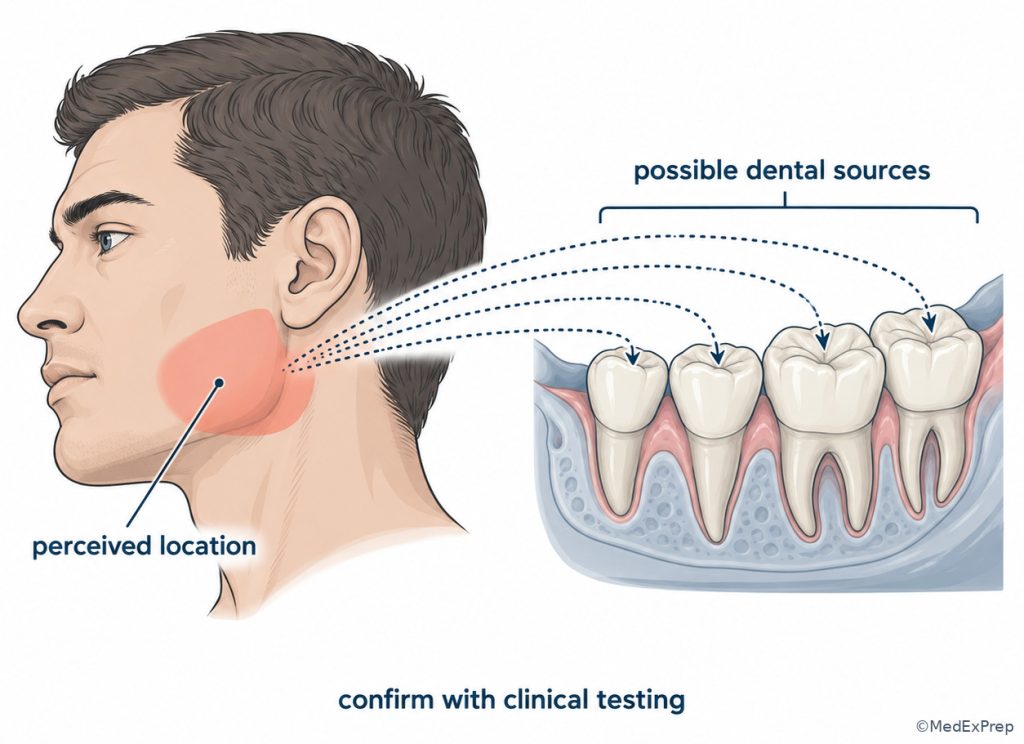
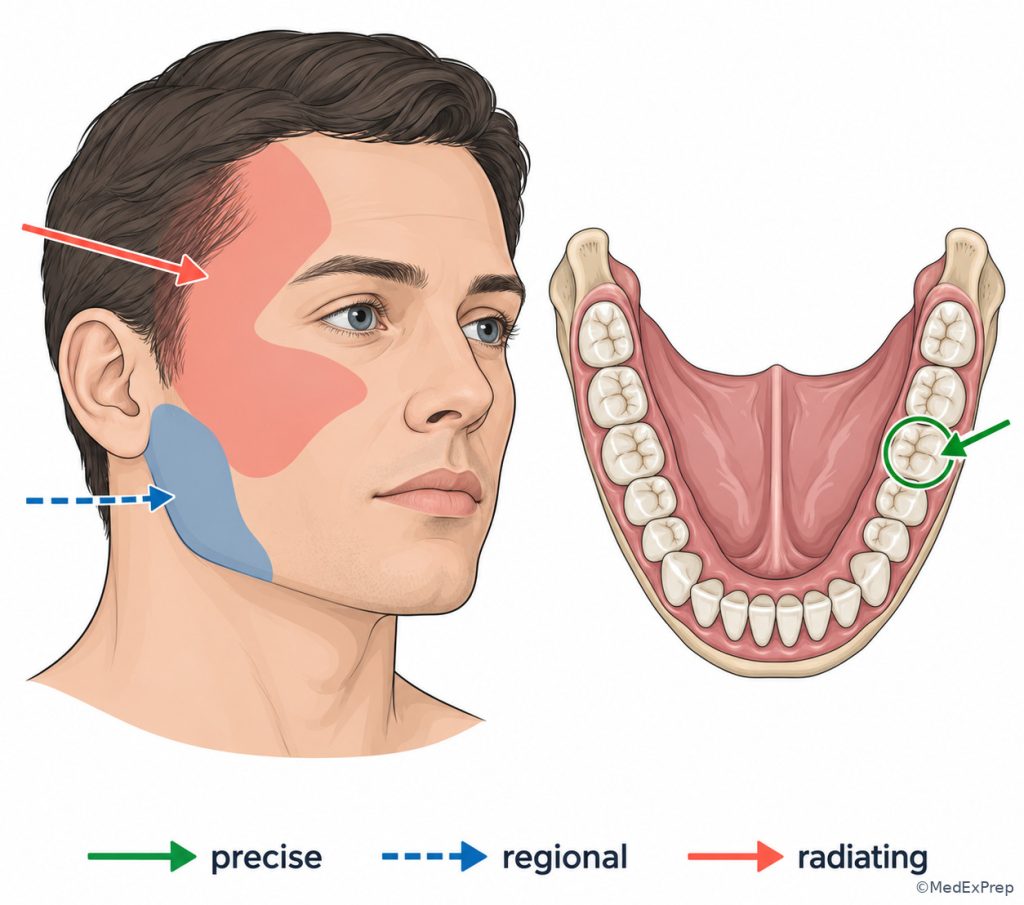
When asking about location, distinguish where pain is perceived from which tooth is suspected. A patient may accurately describe the experience while incorrectly attributing its source. See Fig 2.

Fig 2. Patient-reported pain localization
Exam takeaway: Record perceived pain distribution without assuming that the pointed-to tooth is the source.
1. Listen: Obtain the patient's unprompted chief complaint.
2. Clarify: Establish onset, episode duration, location, and progression.
3. Contextualize: Ask about dental treatment, trauma, medication use, and associated findings.
4. Prioritize: Identify the most plausible diagnostic categories and relevant safety issues.
5. Verify: Select examination findings and tests that can support or challenge each hypothesis.

B. Worked example

A 46-year-old patient with controlled hypertension and gastroesophageal reflux presents with what the patient calls an infected lower molar. Pain began three weeks after a large restoration. The patient reports discomfort from cold beverages but cannot initially specify how long each episode lasts. A small enamel stain on the adjacent premolar attracts the patient's attention, and a recent routine cholesterol result is mentioned but has no direct diagnostic relevance.

  1. Identify the task: Determine the most appropriate next diagnostic action, not whether the patient's proposed diagnosis sounds plausible.
  2. Extract key facts: There is a temporal relationship to restorative treatment, a thermal trigger, uncertain episode duration, and uncertain tooth localization.
  3. Apply the rule: Clarify whether pain persists after removal of the stimulus and examine the restored tooth alongside appropriate neighboring and control teeth.
  4. Eliminate distractors: The adjacent stain does not identify the source. The patient's use of the word infected does not establish pulpal necrosis or an abscess.
  5. Verify: Obtain comparative sensibility responses, percussion and palpation findings, indicated imaging, and relevant restorative examination before assigning diagnoses or recommending irreversible treatment.

C. Exam trap

Common wrong answer: Treat the tooth the patient identifies as infected. Why tempting: The complaint follows a deep restoration and appears anatomically localized. Single eliminating clue: The patient has not established which tooth reproduces the familiar symptoms.

D. Checkpoint MCQ

Question 1. A patient reports two weeks of intermittent pain when drinking cold water. Which additional historical question most directly improves interpretation of the thermal complaint?

  1. A. Does the pain persist after the cold water is removed?
  2. B. Is the pain always perceived in exactly the same part of the mouth?
  3. C. Did the discomfort begin before or after the most recent restoration?
  4. D. Have any analgesics reduced the intensity of the episodes?

Correct answer: A.

  • A: All four questions are relevant, but persistence after stimulus removal directly distinguishes the thermal response patterns under consideration.
  • B: Localization is useful for selecting teeth to test, but it does not establish the temporal character of the thermal response.
  • C: Restorative timing is an important contextual clue, but the question specifically asks how to interpret the reported thermal episodes.
  • D: Analgesic response may modify reported severity, but it does not replace establishing stimulus-response duration.
If you missed this: Review Constructing a structured endodontic history - focus on distinguishing total symptom duration from individual stimulus-response duration.

2. Thermal triggers, duration, and pulpal symptom patterns

A. Explanation

Decision conflict: Does any report of sensitivity to cold indicate irreversible pulpitis, or must the clinician distinguish stimulus-associated discomfort from more concerning persistent or spontaneous symptoms?

WHY THIS IS TESTED: Thermal symptom descriptions are common in board-style diagnostic cases, but interpreting one characteristic in isolation can produce an unsupported pulpal diagnosis.

A history of brief pain associated with a thermal stimulus that resolves promptly after removal can be consistent with reversible pulpal inflammation, depending on examination findings and the absence of stronger contradictory evidence. Lingering thermal pain and spontaneous pain increase concern for symptomatic irreversible pulpitis. They are not independently conclusive, and no universal numerical duration cutoff should substitute for the whole clinical picture.

Heat-related symptoms, poorly localized pain, or discomfort that becomes spontaneous may contribute to a concerning symptom pattern. Absence of a reliable cold response can occur with pulpal necrosis but also with calcification, restoration-related insulation, technical factors, or other limitations of sensibility testing. A historical report of lost thermal sensitivity cannot establish necrosis.

Use Fig 3 to distinguish historical patterns while retaining the requirement for diagnostic confirmation. See Fig 3.

Fig 3. Interpreting thermal symptom duration
Exam takeaway: Thermal response duration changes diagnostic suspicion but does not independently establish pulpal status.
graph TD
A[Patient reports thermal symptoms] --> B{Pain only during stimulus?}
B -->|Yes| C[Clarify prompt resolution and other symptoms]
B -->|No| D[Clarify lingering or spontaneous discomfort]
C --> E[Consider reversible inflammation among differentials]
D --> F[Consider symptomatic irreversible pulpitis among differentials]
E --> G[Confirm with comparative tests and examination]
F --> G

Do not convert a patient's estimate into an arbitrary diagnostic threshold. Establish whether the response is brief or sustained, reproducible, associated with spontaneous symptoms, and consistent with comparative clinical testing.

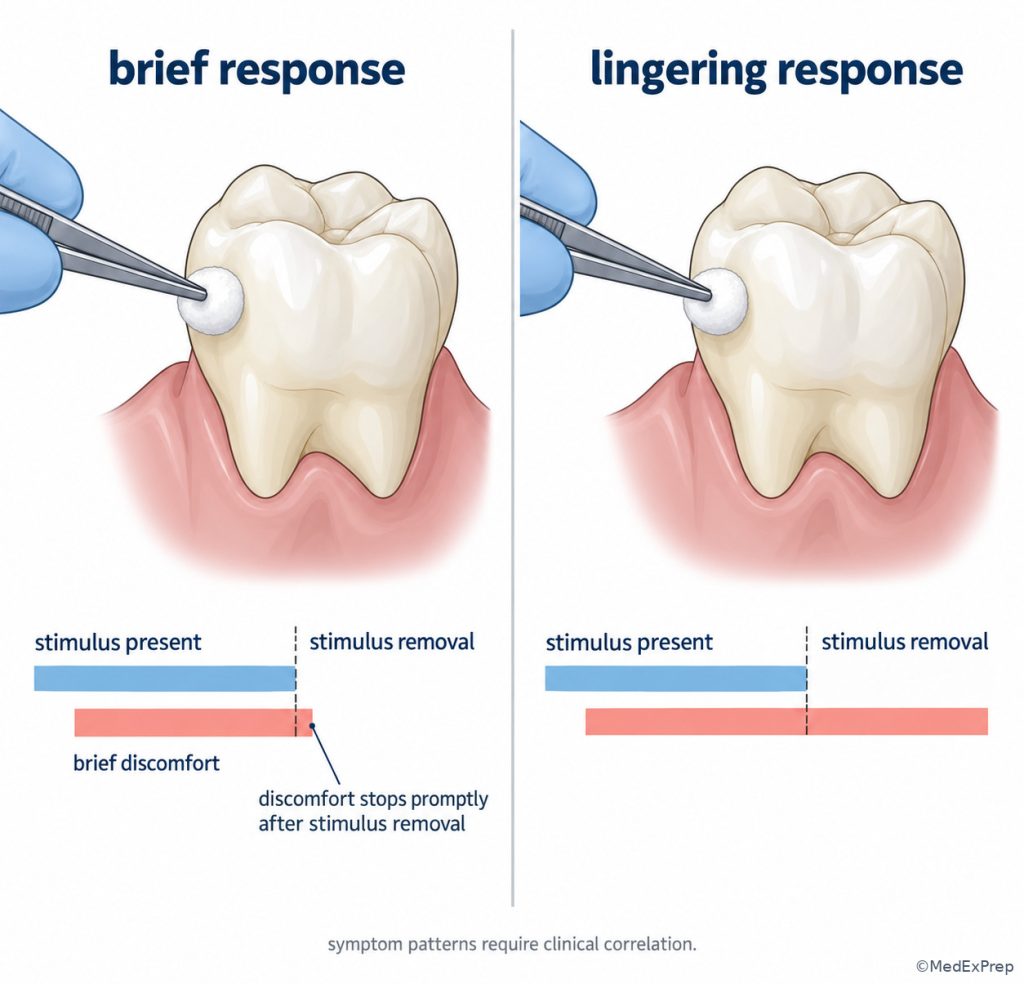
Fig 6. Comparing brief and lingering thermal responses
Exam takeaway: The relationship between stimulus removal and symptom resolution is more discriminating than a pain-intensity adjective alone.
Reported pattern Possible implication Important limitation Verification target
Brief, stimulus-associated thermal pain May support reversible pulpal inflammation. Does not exclude coexisting pathology or another symptomatic tooth. Comparative thermal testing and structural examination.
Lingering thermal pain Raises concern for symptomatic irreversible pulpitis. History alone cannot establish pulpal diagnosis. Reproduction of the complaint and examination concordance.
Spontaneous pain with thermal exacerbation Supports consideration of symptomatic irreversible pulpitis. Other odontogenic and nonodontogenic conditions may overlap. Focused testing and appropriate differential assessment.
No perceived thermal response May occur with necrosis or altered test sensitivity. Restorations, calcification, technique, and other factors can mislead. Multiple comparative findings and indicated imaging.
1. Identify stimulus: Determine which temperature or activity provokes symptoms.
2. Establish timing: Clarify whether discomfort ends promptly or persists after stimulus removal.
3. Screen for spontaneous pain: Ask whether comparable pain occurs without an identifiable stimulus.
4. Generate hypotheses: Prioritize plausible pulpal conditions without making a diagnosis from history alone.
5. Correlate: Perform comparative testing and interpret results alongside the examination.

B. Worked example

A 38-year-old patient with controlled asthma and hypothyroidism reports severe intermittent pain in the upper right posterior region. A crown was placed six months earlier. Cold drinks frequently initiate discomfort that the patient describes as continuing after the drink has been swallowed. The patient also reports occasional spontaneous pain. A mildly elevated routine lipid result is unrelated to the dental complaint. The crowned tooth's appearance is reassuring, making an adjacent unrestored tooth seem more suspicious.

  1. Identify the task: Determine the strongest initial pulpal hypothesis and the next verification step.
  2. Extract key facts: Lingering thermal discomfort and spontaneous episodes are more important than whether the crown looks intact.
  3. Apply the rule: Symptomatic irreversible pulpitis is an important working possibility. Test the crowned tooth, adjacent teeth, and suitable controls while examining restorative and periodontal findings.
  4. Eliminate distractors: An intact-looking crown does not exclude pulpal disease. The patient's pain rating alone does not distinguish pulpal diagnoses.
  5. Verify: Confirm that objective findings and reproduction of the familiar complaint support the implicated tooth before deciding whether endodontic treatment is appropriate.

C. Exam trap

Common wrong answer: Diagnose reversible pulpitis because cold is the principal trigger. Why tempting: Stimulus-associated symptoms commonly accompany reversible inflammation. Single eliminating clue: The patient reports pain continuing after removal of the cold stimulus.

D. Checkpoint MCQ

Question 2. Which historical pattern raises the greatest concern for symptomatic irreversible pulpitis?

  1. A. Brief sensitivity to cold that resolves promptly after stimulus removal.
  2. B. Intermittent cold-associated discomfort with no established episode duration.
  3. C. Lingering thermal pain accompanied by spontaneous episodes.
  4. D. No recollection of any thermal symptoms despite a previous large restoration.

Correct answer: C.

  • A: Brief sensitivity can be clinically relevant but is less suggestive of irreversible inflammation than the combined pattern in C.
  • B: Cold discomfort warrants investigation, but missing duration information prevents meaningful discrimination.
  • C: Lingering thermal discomfort combined with spontaneous pain is a concerning historical pattern, although confirmation remains necessary.
  • D: Lack of recalled thermal symptoms cannot establish either healthy pulp or necrosis.
If you missed this: Review Thermal triggers, duration, and pulpal symptom patterns - focus on the diagnostic importance of lingering and spontaneous pain without assigning a diagnosis from symptoms alone.
Quick Recall:

  • Fill in the blank: Pain that continues after removal of a thermal stimulus is described as ______ thermal pain. Answer: Lingering.
  • True or false: Severe cold sensitivity alone proves symptomatic irreversible pulpitis. Answer: False.
  • One-liner: What should follow a concerning thermal history? Answer: Focused clinical examination and comparative diagnostic testing.

3. Spontaneous pain, biting symptoms, and associated swelling

A. Explanation

Decision conflict: Should spontaneous pain, tenderness when chewing, and swelling be interpreted as interchangeable evidence of one disease process?

WHY THIS IS TESTED: Specialist diagnosis requires distinguishing a predominantly pulpal symptom history from findings suggesting apical tissue involvement and identifying patients who may require urgent intervention.

Spontaneous pain, including episodes that interrupt sleep, can increase concern for significant pulpal inflammation but is not pathognomonic. A patient may also report poorly localized or radiating pain. The history should establish whether such episodes are truly stimulus-independent and whether they resemble the presenting complaint reproduced during testing.

Discomfort on biting, percussion, or pressure suggests that periodontal or periradicular tissues may be involved. Nevertheless, mechanical pain also occurs with cracks, traumatic occlusion, and other conditions. Determine whether the patient experiences pain during loading, on release, or with generalized pressure; these distinctions guide focused clinical testing rather than providing an automatic diagnosis.

Ask directly about swelling, drainage, systemic symptoms, and symptom progression. Swelling associated with suspected odontogenic infection merits prompt assessment. Features suggesting rapidly spreading infection, airway compromise, or systemic instability require urgent escalation within an appropriate emergency and interdisciplinary framework.

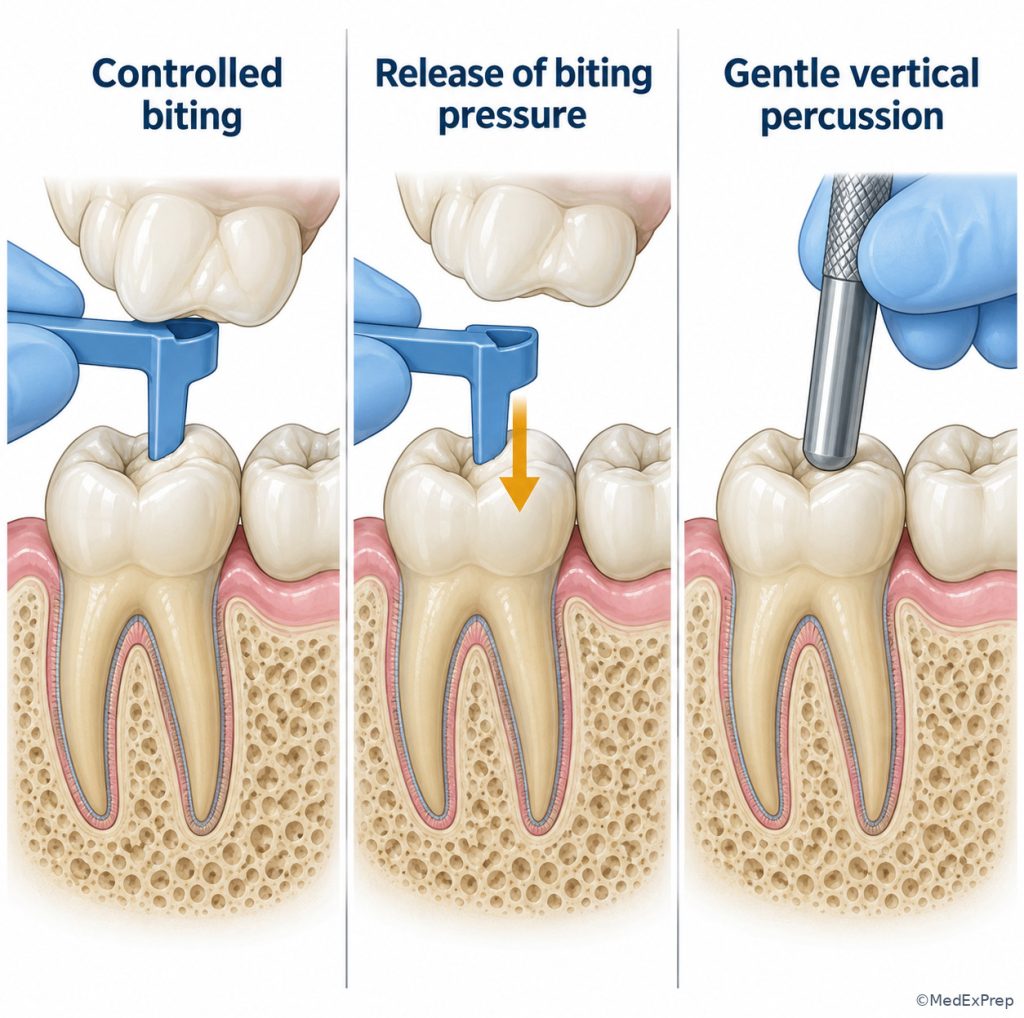
Mechanical pain history and examination targets
Exam takeaway: Pain during loading, release, and percussion creates different testing priorities even when all are described as chewing pain.
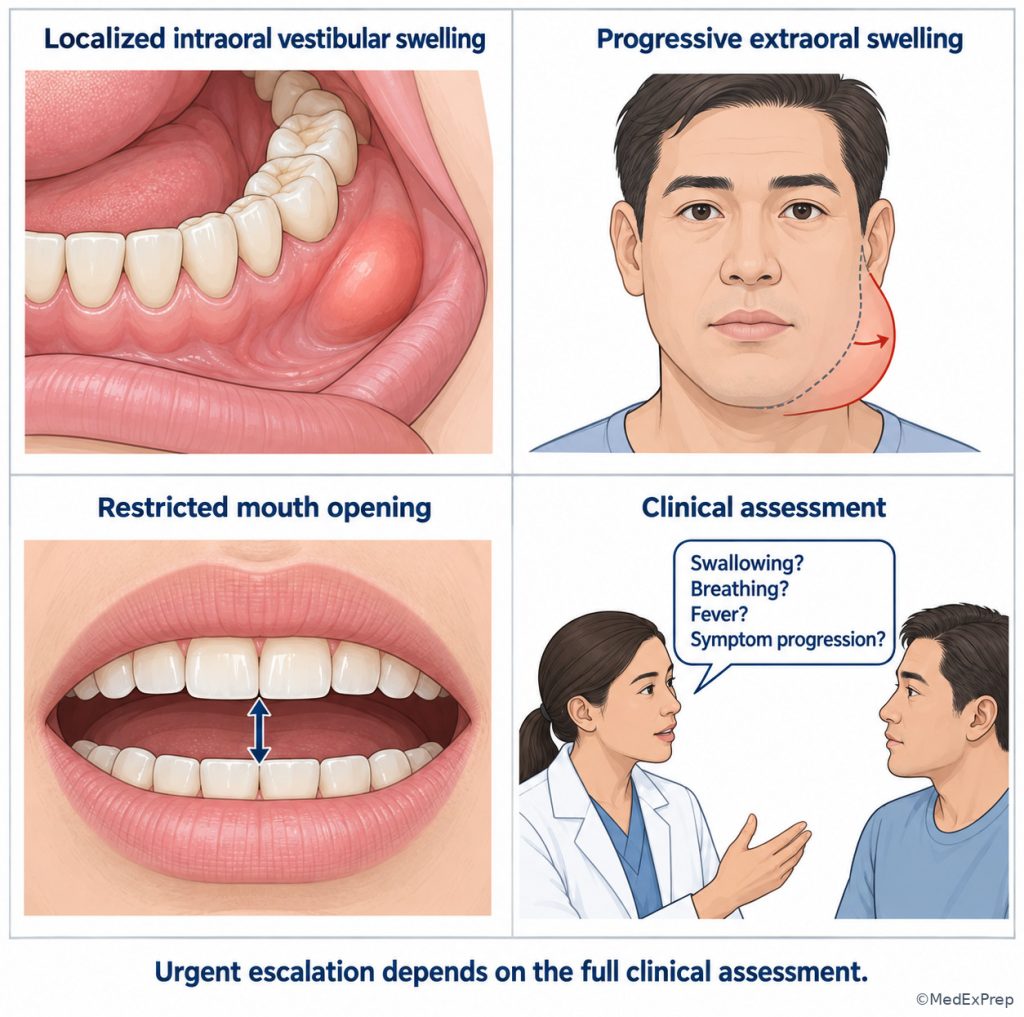
Recognizing swelling-related warning features
Exam takeaway: The history must separate localized dental symptoms from features that may indicate progression or systemic risk.
1. Separate spontaneous pain: Identify symptoms occurring without an immediate trigger.
2. Characterize mechanical pain: Distinguish chewing, percussion-like pressure, and pain on release.
3. Screen associated symptoms: Ask about swelling, drainage, progression, and systemic features.
4. Assess urgency: Identify potential spreading infection or other immediate safety concerns.
5. Correlate: Use clinical tests and indicated imaging to differentiate pulpal, apical, structural, and other causes.

B. Worked example

A 61-year-old patient with type 2 diabetes and hypertension reports increasing discomfort around a mandibular molar previously treated endodontically. The tooth is painful when chewing, and the patient noticed localized gum swelling yesterday. The patient also mentions an old laboratory report showing mildly elevated cholesterol. A neighboring tooth has a large restoration, creating a plausible competing source of pain.

  1. Identify the task: Determine the most appropriate immediate diagnostic priority.
  2. Extract key facts: The previously treated tooth, progressive mechanical discomfort, new swelling, and diabetes all matter to assessment and safe management.
  3. Apply the rule: Promptly evaluate the swelling and assess infection-related safety features while examining the symptomatic region and relevant teeth.
  4. Eliminate distractors: A neighboring restoration does not override the need to examine swelling. A history of previous root canal treatment does not independently establish which tooth is responsible.
  5. Verify: Establish localization using examination, percussion, palpation, periodontal assessment, and indicated imaging. Determine whether the patient is stable and whether urgent endodontic intervention, consultation, or emergency referral is appropriate.

Any medication decision follows the examination and assessment of systemic involvement. Antibiotics are not a substitute for appropriate management of an endodontic source when definitive intervention is indicated and feasible.

C. Exam trap

Common wrong answer: Attribute every report of chewing pain to symptomatic apical periodontitis without considering structural causes. Why tempting: Mechanical pain is a familiar feature of apical inflammation. Single eliminating clue: Pain described specifically on release of biting pressure requires targeted evaluation for a crack or another mechanical explanation.

D. Checkpoint MCQ

Question 3. A patient reports increasing dental pain, rapidly progressive swelling, and new difficulty swallowing. What is the most appropriate initial response?

  1. A. Prioritize routine comparative cold testing before evaluating the swelling.
  2. B. Immediately assess for potentially spreading infection and arrange urgent escalation when indicated.
  3. C. Attribute the symptoms to symptomatic irreversible pulpitis because the patient reports severe pain.
  4. D. Observe for another day to determine whether the swelling localizes sufficiently for endodontic treatment.

Correct answer: B.

  • A: Diagnostic tests remain important, but they must not delay evaluation of potentially serious infection-related warning features.
  • B: Progressive swelling with difficulty swallowing changes the immediate priority to safety assessment and appropriate urgent care.
  • C: Severe pain can accompany pulpal disease, but intensity does not explain or safely classify these associated findings.
  • D: Observation may sometimes be appropriate for selected stable presentations, but new swallowing difficulty makes delay inappropriate.
If you missed this: Review Spontaneous pain, biting symptoms, and associated swelling - focus on recognizing history features that require immediate safety assessment.

4. Misleading histories, referred pain, and competing explanations

A. Explanation

Decision conflict: When a patient identifies a tooth and reports convincing dental pain, should the specialist proceed with treatment despite inconsistent examination findings?

WHY THIS IS TESTED: Incorrect localization and premature diagnostic closure can result in unnecessary irreversible treatment, particularly when symptoms arise from another tooth, a structural problem, or a nonodontogenic source.

Referred pain is clinically important because the perceived location may differ from the source. Histories become especially difficult when pain is diffuse, fluctuating, bilateral, or difficult to reproduce. However, no individual distribution proves that pain is nonodontogenic.

Recent restorative treatment can bias both patient and clinician toward the treated tooth. Similarly, the most visibly damaged tooth is not always responsible for the presenting complaint. A cracked tooth may generate intermittent mechanical or thermal symptoms, while adjacent dental structures can produce overlapping symptom descriptions.

Medication use, adaptation of chewing habits, fluctuating inflammation, and recall limitations can also affect the history. A patient who reports that pain stopped after medication has supplied information about symptom modification, not proof of disease resolution.

When the clinical findings do not support the suspected tooth, broaden the differential. Consider additional dental testing and, where appropriate, evaluation for nonodontogenic pain. See Fig 4 for the decision sequence.

Fig 4. Managing discordant symptom localization
Exam takeaway: Inconsistent history and examination findings should trigger reassessment rather than irreversible treatment based on the patient's preferred tooth.
graph TD
A[Patient identifies suspected tooth] --> B[Perform focused examination and comparative tests]
B --> C{Findings concordant?}
C -->|Yes| D[Integrate pulpal apical and structural evidence]
C -->|No| E[Reconsider adjacent teeth referral and test limitations]
E --> F{Source adequately established?}
F -->|No| G[Expand differential or arrange appropriate consultation]
F -->|Yes| D

Do not assume that referral follows one fixed anatomic pattern. The clinical objective is to establish an evidence-supported source and recognize when the endodontist should defer treatment. See Fig 5.

Fig 5. Perceived pain versus possible dental sources
Exam takeaway: The apparent pain location should direct investigation but must not determine treatment without corroborating findings.
Presentation Tempting assumption Alternative explanation to assess Discriminating action
Pain perceived in one molar but tests are inconsistent The identified molar must be responsible. Referred pain from another tooth or a nonodontogenic source. Test adjacent and appropriate control teeth and reassess symptom reproduction.
Pain follows recent restorative treatment The restored tooth must have irreversible pulpitis. Transient pulpal irritation, structural factors, occlusal problems, or another source. Characterize symptom duration and perform focused testing.
Pain occurs primarily when chewing The patient necessarily has apical periodontitis. Crack-related or other mechanical pain. Clarify loading versus release and conduct appropriate bite and structural examination.
Symptoms persist despite discordant dental findings A normal-looking tooth needs exploratory treatment. Unidentified dental disease or nonodontogenic pain. Reassess testing and imaging; consider consultation or referral.
1. Record: Document the patient's perceived site and characteristic symptoms.
2. Test: Examine the suspected tooth and relevant comparison teeth.
3. Compare: Determine whether the objective findings reproduce and explain the familiar complaint.
4. Reconsider: If discordant, assess technical limitations, neighboring teeth, structural causes, and referred pain.
5. Decide: Treat only when adequately supported; otherwise defer, investigate, consult, or refer.

B. Worked example

A 53-year-old patient with migraine and controlled hypertension reports severe pain believed to originate from a maxillary molar. The patient recently had a restoration placed on that tooth and strongly requests root canal treatment. Pain sometimes spreads toward the temple. Comparative thermal testing does not reproduce the familiar complaint, percussion findings are unremarkable, and preliminary imaging offers no convincing explanation. A routine laboratory result for vitamin D is mentioned but has no direct diagnostic significance.

  1. Identify the task: Decide whether the evidence supports immediate irreversible treatment.
  2. Extract key facts: The recent restoration is relevant, but the examination fails to corroborate the patient's proposed source; the pain distribution and migraine history broaden the differential.
  3. Apply the rule: Do not treat a tooth solely because its treatment history makes it suspicious. Reassess the complaint, examination methods, adjacent teeth, and relevant diagnostic findings.
  4. Eliminate distractors: Severe pain and a patient's confidence in localization do not establish pulpal disease. Equally, migraine history does not prove that the current complaint is nonodontogenic.
  5. Verify: If the source remains uncertain, defer irreversible treatment and arrange appropriate additional evaluation or referral.

C. Exam trap

Common wrong answer: Perform root canal treatment because the restored tooth is the patient's preferred target. Why tempting: Recent dental treatment provides an apparently coherent explanation. Single eliminating clue: The available dental findings do not corroborate the suspected source.

D. Checkpoint MCQ

Question 4. A patient reports severe pain in a specific tooth, but repeated appropriate dental tests and the examination do not establish a concordant source. What is the best next step?

  1. A. Proceed with endodontic treatment because the patient consistently identifies the same tooth.
  2. B. Diagnose nonodontogenic pain solely because dental findings are inconclusive.
  3. C. Broaden the differential, reassess the relevant findings, and defer irreversible treatment until adequately justified.
  4. D. Interpret reported pain severity as sufficient evidence of irreversible pulpal inflammation.

Correct answer: C.

  • A: Consistent localization is valuable historical information but does not replace diagnostic corroboration.
  • B: Nonodontogenic pain is an important possibility, but inconclusive findings do not establish that diagnosis.
  • C: Expanded assessment and appropriate deferral avoid premature treatment while preserving the opportunity to identify a valid source.
  • D: Pain severity influences clinical urgency and patient experience but cannot independently determine pulpal diagnosis.
If you missed this: Review Misleading histories, referred pain, and competing explanations - focus on requiring diagnostic concordance before irreversible treatment.
Quick Recall:

  • True or false: A recent restoration proves that the restored tooth is the source of subsequent pain. Answer: False.
  • Fill in the blank: Pain perceived away from its source is called ______ pain. Answer: Referred.
  • One-liner: What should significant disagreement between history and examination trigger? Answer: Reassessment and an appropriately broadened differential diagnosis.

5. Integrating the history into a safe diagnostic decision

A. Explanation

Decision conflict: When the history suggests a familiar endodontic disorder, is the next step immediate treatment, additional testing, urgent intervention, or referral?

WHY THIS IS TESTED: Board-level clinical reasoning requires identifying what the available evidence establishes, recognizing missing information, and selecting the safest appropriate next action.

Begin by assessing urgency. A stable patient with localized thermal symptoms generally follows a different diagnostic pathway from a patient with progressive facial swelling, difficulty swallowing, or other concerning systemic features. Immediate safety concerns take precedence over routine diagnostic sequencing.

For a stable presentation, use the history to choose a focused examination. Thermal symptoms direct attention toward appropriate sensibility testing; biting complaints support mechanical and periradicular assessment; swelling prompts careful evaluation of soft tissues, drainage, infection-related features, and possible origin. Diagnostic testing must still be comprehensive enough to avoid confirmation bias.

Interpret the findings within two linked but distinct diagnostic domains: pulpal status and apical tissue status. A history may support a working diagnosis, but final diagnostic terminology should reflect corroborating examination and testing. When restorability, a suspected fracture, major periodontal compromise, systemic risk, or another specialty's expertise controls the decision, consultation or coordinated care is appropriate.

Document the patient's account, relevant positive and negative findings, competing explanations, working conclusions, uncertainty, and reasons for the selected next step.

History-to-examination integration
Exam takeaway: A specialist links each important historical finding to a relevant examination target before committing to treatment.
1. Safety first: Identify infection-related warning features and other urgent risks.
2. Define the problem: Summarize the most discriminating historical characteristics.
3. Test hypotheses: Perform targeted clinical examination, comparative tests, and indicated imaging.
4. Integrate: Assess diagnostic concordance, competing causes, and restorability implications.
5. Select the next action: Provide justified treatment, obtain additional evidence, or arrange consultation, referral, or urgent escalation.

B. Worked example

A 29-year-old patient with controlled asthma and a history of anxiety presents with intermittent cold sensitivity and mild chewing discomfort around a recently restored mandibular premolar. The patient is concerned that an unrelated earlier dental infection is recurring. The current examination reveals no reported swelling or systemic symptoms. A normal recent hemoglobin result is volunteered but does not explain the complaint. Thermal response duration and the exact pattern of chewing discomfort have not yet been established.

  1. Identify the task: Choose the best next step from immediate endodontic treatment, empirical medication, observation without further assessment, or focused diagnostic evaluation.
  2. Extract key facts: The clinical history contains thermal and mechanical symptoms, recent restorative treatment, and unresolved distinctions essential to diagnosis.
  3. Apply the rule: Complete the symptom history and perform the relevant diagnostic examination before deciding whether the pulp is reversibly or irreversibly inflamed or whether another mechanism explains the symptoms.
  4. Eliminate distractors: A previous unrelated infection does not establish current infection. Anxiety does not invalidate reported pain. The absence of swelling alone does not determine pulpal status.
  5. Verify: Compare responses with appropriate control teeth, examine the restoration and periodontal tissues, assess mechanical symptoms, and obtain indicated imaging before selecting treatment or review.

C. Exam trap

Common wrong answer: Prescribe antibiotics because the patient reports a previous dental infection and requests preventive treatment. Why tempting: Familiar infection terminology and patient concern create pressure to intervene immediately. Single eliminating clue: The current history supplies no established indication for systemic antibiotic therapy.

D. Checkpoint MCQ

Question 5. A medically stable patient has a concerning but incomplete history of thermal and mechanical dental pain, with no identified urgent warning features. Which is the most appropriate next step?

  1. A. Initiate root canal treatment based on the combined symptom descriptions.
  2. B. Complete the relevant history and perform focused comparative diagnostic testing.
  3. C. Diagnose symptomatic apical periodontitis because chewing discomfort is reported.
  4. D. Prescribe antibiotics before further assessment because both thermal and mechanical symptoms are present.

Correct answer: B.

  • A: The symptoms may ultimately support treatment, but the source and diagnosis remain inadequately established.
  • B: Focused history completion and corroborating examination directly address the remaining uncertainty.
  • C: Chewing symptoms raise a differential consideration but cannot independently establish apical disease.
  • D: Combined symptoms do not create an antibiotic indication without appropriate clinical assessment.
If you missed this: Review Integrating the history into a safe diagnostic decision - focus on matching the next action to diagnostic certainty and urgency.

Exam Traps & Differentiators

Common traps & distractors

  • Wrong answer: Diagnose irreversible pulpitis solely from intense pain. Why tempting: Severe pain appears clinically important. Single clue: The diagnostic pattern and objective findings have not been established.
  • Wrong answer: Diagnose necrosis because the patient no longer notices cold sensitivity. Why tempting: Loss of thermal perception resembles loss of pulpal sensation. Single clue: There is no corroborating clinical testing.
  • Wrong answer: Treat the tooth that hurts when the patient points to it. Why tempting: Patient localization appears precise. Single clue: Reproduction of the familiar complaint has not been confirmed.
  • Wrong answer: Assume any biting pain proves an endodontic apical disorder. Why tempting: Apical inflammation commonly produces mechanical tenderness. Single clue: A release-specific symptom suggests the need for structural examination.
  • Wrong answer: Delay assessment when swelling is progressing. Why tempting: Waiting for localization seems diagnostically convenient. Single clue: New swallowing difficulty or another serious warning feature changes the immediate priority.

Looks similar but isn't

Historical pattern Competing interpretation Best differentiator
Brief cold-provoked pain Lingering thermal pain Whether symptoms persist after stimulus removal.
Spontaneous pain Repeated provoked pain mistaken for spontaneity Whether an immediate trigger can be identified for the relevant episodes.
Pain with biting Pain on release of biting pressure Careful symptom clarification and controlled tooth-specific mechanical examination.
Localized reported toothache Referred or incorrectly localized pain Concordance between perceived location and clinical reproduction of the familiar complaint.
Previous endodontic treatment with recurrent symptoms Symptoms arising from an adjacent tooth or another source Current findings rather than treatment history alone.
Localized discomfort without systemic features Potentially spreading odontogenic infection Swelling progression, systemic status, and concerning swallowing or breathing symptoms.

If the stem says...

  • Lingering after cold is removed: Think increased concern for symptomatic irreversible pulpitis; obtain corroborating findings.
  • Cannot identify a specific tooth: Think localization uncertainty and comparative testing.
  • Pain specifically on release: Think targeted evaluation for a crack or another mechanical cause.
  • Recently restored tooth: Think relevant treatment history, not automatic proof of pulpal disease.
  • Progressive swelling with swallowing difficulty: Think urgent safety assessment and possible emergency escalation.
  • Severe pain with inconclusive dental findings: Think diagnostic reassessment and a broader differential before irreversible treatment.
Review connection: Return to Misleading histories, referred pain, and competing explanations when a vignette offers an apparently convincing symptom history but insufficient evidence identifying its source.

Algorithm / Approach

Use this five-step sequence for a history-centered endodontic diagnostic vignette. The sequence identifies the appropriate next decision rather than substituting a fixed treatment for every symptom pattern.

Step 1 - Assess safety: Determine whether progressive swelling, swallowing or breathing difficulty, systemic illness, or another urgent concern requires immediate escalation.
Step 2 - Characterize symptoms: Establish onset, location, thermal and mechanical triggers, episode duration, spontaneous symptoms, progression, and associated findings.
Step 3 - Establish context: Review restorations, previous endodontic care, trauma, medication use, medical risks, and competing explanations.
Step 4 - Verify and integrate: Perform relevant examination, comparative testing, and indicated imaging; interpret pulpal and apical evidence separately.
Step 5 - Choose the action: Treat when adequately justified, obtain further evidence when uncertain, or coordinate appropriate consultation, referral, or urgent care.

In a board-style question, first identify whether the examiner is asking for the most likely working diagnosis, the most appropriate next diagnostic test, or the safest immediate action. These are not interchangeable tasks.

Self-check quiz

Select the single best answer for each question. Difficulty progresses from foundational interpretation to integrated specialist decision-making.

1. Foundational - Thermal symptoms. A 35-year-old patient reports cold-provoked pain around a mandibular premolar. Which additional historical feature most directly separates brief stimulus-associated symptoms from a more concerning lingering pattern?

  1. A. Whether the premolar received restorative treatment during the previous year.
  2. B. Whether the pain continues after the cold stimulus is removed.
  3. C. Whether the patient can identify the tooth without assistance.
  4. D. Whether the patient has occasionally taken an analgesic.

2. Foundational - Diagnostic interpretation. A patient reports lingering pain after exposure to cold and occasional spontaneous episodes. Which conclusion is most appropriate before objective testing?

  1. A. The patient has confirmed symptomatic irreversible pulpitis.
  2. B. The patient has confirmed pulpal necrosis.
  3. C. The history increases concern for symptomatic irreversible pulpitis but requires clinical correlation.
  4. D. The history establishes symptomatic apical periodontitis independently of mechanical findings.

3. Application - Mechanical symptoms. A 49-year-old patient describes sharp discomfort specifically when releasing pressure after biting on one side. Which is the most appropriate next diagnostic emphasis?

  1. A. Focused bite and structural examination, including assessment for a crack.
  2. B. Immediate classification as symptomatic apical periodontitis.
  3. C. Classification as symptomatic irreversible pulpitis based solely on the sharp character of pain.
  4. D. Classification as pulp necrosis because release pain is a mechanical symptom.

4. Integration - Discordant findings. A patient strongly identifies a recently crowned molar as the source of persistent pain. Appropriate clinical testing and examination do not corroborate the location, and the complaint is not reliably reproduced. What is the most appropriate action?

  1. A. Initiate treatment of the crowned molar because recent dental work provides a plausible cause.
  2. B. Expand the differential and reassess before committing to irreversible treatment.
  3. C. Diagnose nonodontogenic pain immediately because the initial dental examination is inconclusive.
  4. D. Select the adjacent tooth for treatment because referred pain is possible.

5. Integration - Urgency. A patient with worsening posterior dental pain reports progressive facial swelling and new difficulty swallowing. What is the most appropriate immediate priority?

  1. A. Complete routine cold and percussion testing before considering the associated symptoms.
  2. B. Schedule nonurgent reassessment after determining whether analgesics control the pain.
  3. C. Provide routine empirical antibiotic therapy without assessing the patient's current stability.
  4. D. Evaluate for potentially serious infection-related complications and arrange urgent escalation as indicated.

Answer key & explanations

Question 1 - Answer: B

  • A - Incorrect: Restorative history is tempting because it may explain symptom onset, but it does not directly establish thermal episode duration.
  • B - Correct: Persistence after stimulus removal is the discriminating historical feature requested; the finding still requires clinical correlation.
  • C - Incorrect: Localization is useful for choosing examination targets but does not characterize the response after stimulus removal.
  • D - Incorrect: Analgesic use can modify symptom severity, but it is less directly relevant than the timing of pain resolution.
If you missed this: Review Thermal triggers, duration, and pulpal symptom patterns - focus on distinguishing brief from lingering thermal responses.

Question 2 - Answer: C

  • A - Incorrect: This is tempting because the history is concerning, but confirmation requires correlation with the clinical examination and diagnostic tests.
  • B - Incorrect: Necrosis may occur in symptomatic presentations, but lingering thermal pain does not establish complete loss of pulpal vitality.
  • C - Correct: The combined historical pattern increases concern for symptomatic irreversible pulpitis while preserving the need for verification.
  • D - Incorrect: Pulpal symptoms and apical tissue findings represent distinct diagnostic domains; the history provided does not independently establish apical inflammation.
If you missed this: Review Thermal triggers, duration, and pulpal symptom patterns - focus on distinguishing a working diagnostic hypothesis from an established diagnosis.

Question 3 - Answer: A

  • A - Correct: Release-specific discomfort appropriately directs attention to tooth-specific mechanical testing and potential structural causes.
  • B - Incorrect: Apical periodontitis can produce biting discomfort, making this tempting, but the distinctive release-related symptom requires a broader mechanical assessment.
  • C - Incorrect: Sharp pain may occur in several disorders and cannot establish a pulpal diagnosis independently.
  • D - Incorrect: Mechanical symptom character does not determine whether the pulp is necrotic; objective evidence is necessary.
If you missed this: Review Spontaneous pain, biting symptoms, and associated swelling - focus on distinguishing pain during loading from pain on release.

Question 4 - Answer: B

  • A - Incorrect: Recent restorative treatment offers a plausible explanation, but treating without sufficient localization and corroboration risks unnecessary irreversible intervention.
  • B - Correct: Significant diagnostic discordance warrants reassessment, additional evidence where appropriate, and consideration of alternative sources.
  • C - Incorrect: Nonodontogenic pain belongs in the differential, but an inconclusive examination does not independently establish that diagnosis.
  • D - Incorrect: Referred pain makes neighboring teeth relevant to examination; it does not identify an alternative tooth for immediate treatment.
If you missed this: Review Misleading histories, referred pain, and competing explanations - focus on requiring corroborating findings before irreversible treatment.

Question 5 - Answer: D

  • A - Incorrect: Routine testing may become relevant after stabilization, but potentially serious warning features require immediate consideration.
  • B - Incorrect: Analgesic response may affect comfort but cannot safely resolve concerns created by progressive swelling and swallowing difficulty.
  • C - Incorrect: Antibiotics may form part of appropriate care in selected infections, but empirical prescribing without evaluating severity, stability, and necessary escalation is inadequate.
  • D - Correct: Progressive swelling with difficulty swallowing requires prompt assessment for potentially serious complications and urgent management or referral when indicated.
If you missed this: Review Integrating the history into a safe diagnostic decision - focus on recognizing safety priorities before routine diagnostic sequencing.

Rapid review / cheat-sheet

  • Chief complaint -> Capture the patient's words before imposing a diagnostic label.
  • Episode duration -> Separate each pain episode from the overall duration of the complaint.
  • Lingering thermal pain -> Raises concern for significant pulpal inflammation but requires corroboration.
  • Spontaneous pain -> Investigate whether the episode genuinely occurred without an identifiable immediate trigger.
  • Mechanical pain -> Clarify loading, release, and pressure before selecting focused testing.
  • Previous treatment -> Provides context without identifying the responsible tooth by itself.
  • Absent recalled sensitivity -> Is not equivalent to confirmed pulpal necrosis.
  • Perceived localization -> Identifies examination targets rather than proving the source.
  • Discordant findings -> Expand the differential before irreversible intervention.
  • Progressive swelling -> Screen immediately for systemic and spreading-infection warning features.
  • Dual diagnostic framework -> Evaluate pulpal and apical findings separately.
  • Best next step -> Match the action to urgency, available evidence, diagnostic uncertainty, and specialist scope.

Blueprint anchor and further study

Primary blueprint anchor: Diagnosis and clinical evaluation.

Mapped objectives: Structured symptom-history acquisition; thermal and mechanical symptom characterization; recognition of prior treatment and trauma; correlation of symptoms with pulpal and apical diagnostic possibilities; recognition of referred pain, diagnostic discordance, and urgent clinical warning features.

Blueprint weighting: Not specified in the supplied course blueprint. The educational emphasis reflects the foundational role of clinical history in specialist endodontic diagnosis rather than an asserted examination percentage.

See also: Diagnostic Terminology Standards (ch01.s01.t01); Pulp Vitality Test Interpretation (ch01.s01.t03); Pulpal Apical Diagnosis Synthesis (ch01.s01.t04); Percussion Palpation Mobility Probing (ch01.s02.t02); Crack And Bite Testing (ch01.s02.t03); Odontogenic Pain Patterns (ch01.s04.t01); Nonodontogenic Pain Red Flags (ch01.s04.t02).

Further study: Continue with the course's diagnostic testing and pulpal-apical synthesis topics. The supplied blueprint identifies the competency domain but does not specify proprietary ABE question formats, numerical domain weighting, or a mandatory diagnostic testing protocol. Apply accepted specialist terminology and current clinical standards while recognizing that appropriate testing may differ across clinical presentations.

Keep reading, free

Enter your email to read lesson 2 now.

Free. We may also email you about our programs. No spam, and you can ask us to remove your email at any time.

Liked it?

Endodontics Board Prep Course (Endo) has 99 lessons.

DLOSCEPrep
Programs
For organizations
ContactLog inGet a free guide